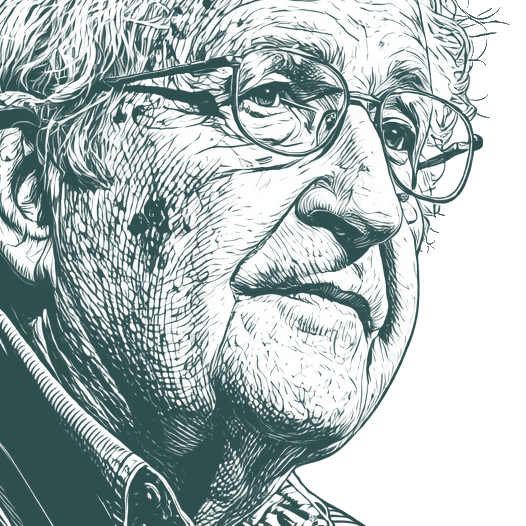
in the United States, political discourse and debate has often been less diversified even than in certain Fascist countries, Franco Spain, for exampl… - Noam Chomsky

" "

in the United States, political discourse and debate has often been less diversified even than in certain Fascist countries, Franco Spain, for example, where there was lively discussion covering a broad ideological range. Though the penalties for deviance from official doctrine were incomparably more severe than here, nevertheless opinion and thinking was not constrained within such narrow limits, a fact that frequently occasioned surprise among Spanish intellectuals visiting the United States during the latter years of the Franco period. Much the same was true in Fascist Portugal, where there seem to have been significant Marxist groups in the universities, to mention just one example. The range and significance of the ideological diversity became apparent with the fall of the dictatorship, and is also reflected in the liberation movements in the Portuguese colonies — a two-way street, in that case, in that the Portuguese intellectuals were influenced by the liberation movements, and conversely, I suppose.

English
Collect this quote

About Noam Chomsky

Avram Noam Chomsky (born 7 December 1928) is an American linguist, analytical philosopher, cognitive scientist, political analyst, human rights activist and anarcho-socialist.

Biography information from Wikiquote

Also Known As

Birth Name: Avram Noam Chomsky
Alternative Names: A. Noam Chomsky Chomsky
Unlimited Quote Collections

Organize your favorite quotes without limits. Create themed collections for every occasion with Premium.

Related quotes. More quotes will automatically load as you scroll down, or you can use the load more buttons.

Additional quotes by Noam Chomsky

Personally I'm very much opposed to Hamas' policies in almost every respect. However, we should recognize that the policies of Hamas are more forthcoming and more conducive to a peaceful settlement than those of the United States or Israel. ... So, for example, Hamas has called for a long-term indefinite truce on the international border. There is a long-standing international consensus that goes back over thirty years that there should be a two-state political settlement on the international border, the pre-June 1967 border, with minor and mutual modifications. That's the official phrase. Hamas is willing to accept that as a long-term truce. The United States and Israel are unwilling even to consider it... The demand on Hamas by the United States and the European Union and Israel [...] is first that they recognize the State of Israel. Actually, that they recognize its right to exist. Well, Israel and the U.S. certainly don't recognize the right of Palestine to exist, nor recognize any state of Palestine. In fact, they have been acting consistently to undermine any such possibility. The second condition is that Hamas must renounce violence. Israel and the United States certainly do not renounce violence. The third condition is that Hamas accept international agreements. The United States and Israel reject international agreements. So, though the policies of Hamas are, again in my view, unacceptable, they happen to be closer to the international consensus on a political peaceful settlement than those of their antagonists, and it's a reflection of the power of the imperial states - the United States and Europe - that they are able to shift the framework, so that the problem appears to be Hamas' policies, and not the more extreme policies of the United States and Israel... And we must remember that in their case it's not just policies. It's not words - it's actions.

Twenty years ago, Dwight Macdonald published a series of articles in Politics on the responsibility of peoples and, specifically, the responsibility of intellectuals. I read them as an undergraduate, in the years just after the war, and had occasion to read them again a few months ago. They seem to me to have lost none of their power or persuasiveness. Macdonald is concerned with the question of war guilt . He asks the question: To what extent were the German or Japanese people responsible for the atrocities committed by their governments? And, quite properly, he turns the question back to us: To what extent are the British or American people responsible for the vicious terror bombings of civilians, perfected as a technique of warfare by the Western democracies and reaching their culmination in Hiroshima and Nagasaki, surely among the most unspeakable crimes in history.

authority, unless justified, is inherently illegitimate and that the burden of proof is on those in authority. If this burden can't be met, the authority in question should be dismantled.

Loading...