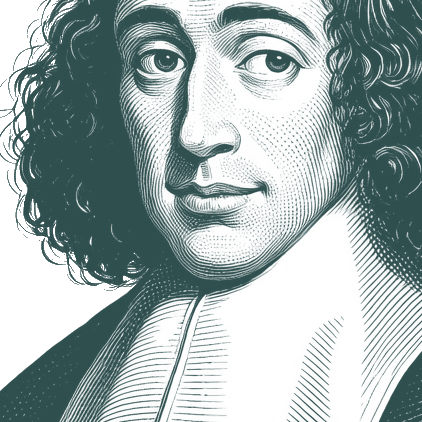
Spinoza was a republican democrat and a supporter of the politician Johan De Witt (1625–72), an opponent of the House of Orange. After De Witt's deat… - Benedictus de Spinoza
""
Spinoza was a republican democrat and a supporter of the politician Johan De Witt (1625–72), an opponent of the House of Orange. After De Witt's death, the aristocratic Orange faction took power and restored a more conventional social order (which was subsequently imposed on Britain when one of them acquired the English throne in 1689). By that time ‘Spinozism’ was already a thriving underground cult with ardent supporters in many countries: ‘The battle was on to fix the image of the dying Spinoza in the perceptions and imagination of posterity,’ Israel writes, since ‘the final hours of a thinker who seeks to transform the spiritual foundations of the society around him become heavily charged with symbolic significance in the eyes of both disciples and adversaries.’ Plainly, this battle still continues. It is not to disregard or minimise such a striking lineage to observe that Spinozism had limitations associated with the society it came from, in which countries were struggling to emerge from absolutism and theocratic tyranny. Today, Spinoza's greatness has to be defended against the delusions of a belated progeny, rather as Marx had to be in the later 19th and 20th centuries.
English
Collect this quote
About
Benedictus de Spinoza
Benedictus de Spinoza (24 November 1632 – 21 February 1677) was a social and metaphysical philosopher known for the elaborate development of his monist philosophy, which has become known as Spinozism. Controversy regarding his ideas led to his excommunication from the Jewish community of his native Amsterdam. He was named Baruch ("blessed" in Hebrew) Spinoza by his synagogue elders and known as Bento de Spinoza or Bento d'Espiñoza, but afterwards used the name Benedictus ("blessed" in Latin) de Spinoza.
Native Name:
בָּרוּךְ שְׂפִּינוֹזָה
•
Benedito de Espinosa
Alternative Names:
Benedict de Spinoza
•
Baruch de Espinosa
•
Barukh Shpinozah
•
Benoît de Spinoza
•
Sbīnūzā
•
Ispīnūzā
•
Barukh Spinoza
•
Bento de Espinosa
•
Baruch d' Espinoza
•
Shpinozah
•
Baruch de Spinoza
•
Spinoza
•
Benoit de Spinoza
•
Benedictus De Spinoza
•
Benedictus Spinoza
•
Baruch Spinoza
•
Baruch Benedictus de Spinoza
So I resolved to write a novel about his inner life. That was where my personal expertise might help in telling Spinoza's story. After all, he was a human being and therefore must have struggled with the same basic human conflicts that troubled me and the many patients I've worked with over the decades. He must have had a strong emotional response to being excommunicated, at the age of twenty-four, by the Jewish community in Amsterdam—an irreversible edict that ordered every Jew, including his own family, to shun him forever. No Jew would ever again speak to him, have commerce with him, read his words, or come within fifteen feet of his physical presence. And of course no one lives without an inner life of fantasies, dreams, passions, and a yearning for love. About a fourth of Spinoza's major work, Ethics, is devoted to “overcoming the bondage of the passions.” As a psychiatrist, I felt convinced that he could not have written this section unless he had experienced a conscious struggle with his own passions.
I care not for the girdings of superstition, for superstition is the bitter enemy of knowledge & true morality. Yes; it has come to this! Men who openly confess that they can form no idea of God, & only know him through created things, of which they know not the causes, can unblushingly accuse philosophers of Atheism.
Limited Time Offer
Premium members can get their quote collection automatically imported into their Quotewise collections.
The first thinker to introduce the purely monistic conception of substance into science and appreciate its profound importance was the great philosopher Baruch Spinoza; his chief work appeared shortly before his death in 1677, just one hundred years before Lavoisier gave empirical proof of the constancy of matter by means of the chemist's principle instrument, the balance. In his stately pantheistic system the notion of the world (the universe, or the cosmos) is identical with the all-pervading notion of God; it is at one and the same time the purest and most rational monism and the clearest and most abstract monotheism. This universal substance, this “divine nature of the world,” shows us two different aspects of its being, or two fundamental attributes — matter (indefinitely extended substance) and spirit (the all-embracing energy of thought). All the changes which have since come over the idea of substance are reduced, on a logical analysis, to this supreme thought of Spinoza's; with Goethe I take it to be the loftiest, profoundest, and truest thought of all ages. [Original in German: Der erste Denker, der den reinen monistischen »Substanzbegriff« in die Wissenschaft einführte und seine fundamentale Bedeutung erkannte, war der große Philosoph Baruch Spinoza; sein Hauptwerk erschien kurz nach seinem frühzeitigen Tode, 1677,...]