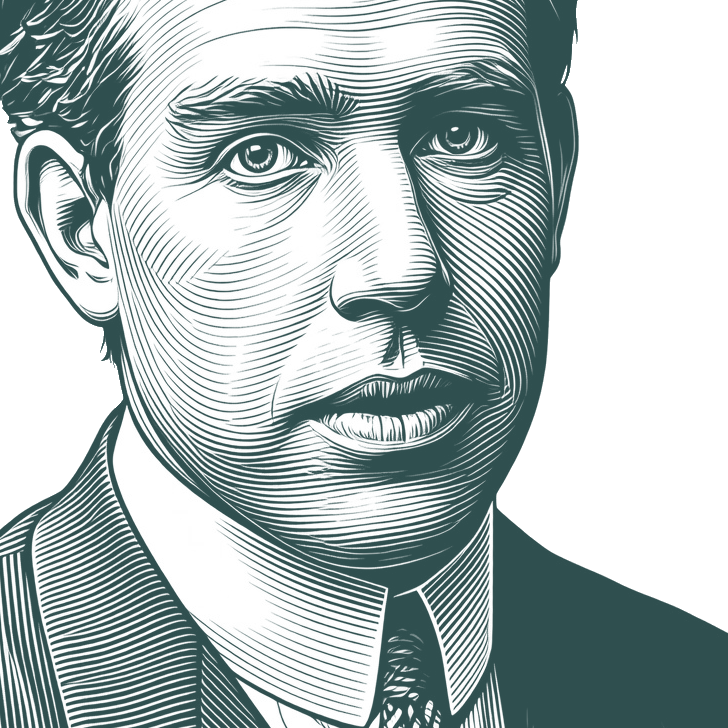
Niels Henrik David Bohr (7 October 1885 – 18 November 1962) was a Danish physicist who made foundational contributions to understanding atomic structure and quantum theory, for which he received the Nobel Prize in Physics in 1922. Bohr was also a philosopher and a promoter of scientific research.
Biography information from
Wikiquote·
Portrait adapted from
Wikimedia Commons, The American Institute of Physics credits the photo [1] to AB Lagrelius & Westphal, which is the Swedish company used by the Nobel Foundation for most photos of its book series Les Prix Nobel. (Public domain / CC0)
Also Known As
Pen Names:
Nicholas Baker
Alternative Names:
Niels Henrik David Bohr
•
N. Bohr
•
N. H. D. Bohr
Portrait from Wikimedia Commons. Credit: The American Institute of Physics credits the photo [1] to AB Lagrelius & Westphal, which is the Swedish company used by the Nobel Foundation for most photos of its book series Les Prix Nobel.. Used under Public domain / CC0. Processed and styled by Quotewise.
PREMIUM FEATURE
Advanced Search Filters
Filter search results by source, date, and more with our premium search tools.
It is the hallmark of any deep truth that its negation is also a deep truth
In quantum mechanics...an observation here and now changes in general the 'state' of the observed system....I consider the unpredictable change of the state by a single observation...to be an abandonment of the idea of the isolation of the observer from the course of physical events outside himself.
If a scientist does not understand a problem, he writes down many formulae, but as soon as he has understood it, there remain at most two.