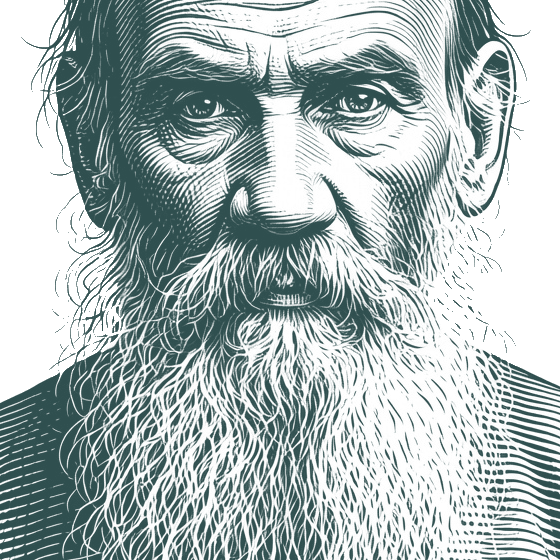
Lev Nikolayevitch Tolstoy [Ле́в Никола́евич Толсто́й, usually rendered Leo Tolstoy, or sometimes Tolstoi] (9 September 1828 – 20 November 1910) was a Russian writer, philosopher and social activist (social critic), whose novels War and Peace and Anna Karenina are internationally praised classics of world literature. He was a major influence on the development of Christian anarchism and pacifism, contributing to such nonviolent resistance movements as those of Mahatma Gandhi, Martin Luther King, Jr., and James Bevel.
Biography information from
Wikiquote·
Portrait adapted from
Wikimedia Commons, Sergei Prokudin-Gorskii (Public domain / CC0)
Also Known As
Pen Names:
Л. Н. Т.
•
Л. Н.
Birth Name:
Lev Nikolayevich Tolstoy
Native Name:
Лев Никола́евич Толсто́й
Alternative Names:
Count Lev Nikolayevich Tolstoy
•
Tolstoy, Leo, graf, 1828-1910
•
Tolstoĭ, Lev Nikolaevich, graf, 1828-1910
•
Lev Nikolayevich Tolstoĭ
•
Leo Tolstoi
•
Tolstoĭ, Lev Nikolaevich, graf
•
Tolstoy, Leo, graf
Yes, love, ...but not the love that loves for something, to gain something, or because of something, but that love that I felt for the first time, when dying, I saw my enemy and yet loved him. I knew that feeling of love which is the essence of the soul, for which no object is needed. And I know that blissful feeling now too. To love one's neighbours; to love one's enemies. To love everything - to Love God in all His manifestations. Some one dear to one can be loved with human love; but an enemy can only be loved with divine love. And that was why I felt such joy when I felt that I loved that man. What happened to him? Is he alive? ...Loving with human love, one may pass from love to hatred; but divine love cannot change. Nothing, not even death, can shatter it. It is the very nature of the soul. And how many people I have hated in my life. And of all people none I have loved and hated more than her.... If it were only possible for me to see her once more... once, looking into those eyes to say...
PREMIUM FEATURE
Advanced Search Filters
Filter search results by source, date, and more with our premium search tools.
Stepan Arkadyevitch took in and read a liberal paper, not an extreme one, but one advocating the views held by the majority. And in spite of the fact that science, art, and politics had no special interest for him, he firmly held those views on all these subjects which were held by the majority and by his paper, and he only changed them when the majority changed them — or, more strictly speaking, he did not change them, but they imperceptibly changed of themselves within him.