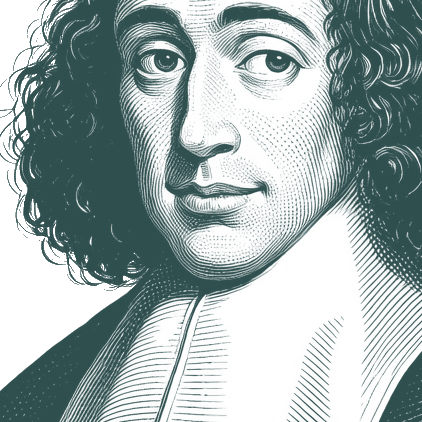
I have had, for my entire life, an extraordinary esteem for the person and for the thinking of that great philosopher. But I do not believe that atti… - Benedictus de Spinoza
""
I have had, for my entire life, an extraordinary esteem for the person and for the thinking of that great philosopher. But I do not believe that attitude gives me the right to say anything publically about him, for the good reason that I would have nothing to say that has not been said by others.
Benedictus de Spinoza (24 November 1632 – 21 February 1677) was a social and metaphysical philosopher known for the elaborate development of his monist philosophy, which has become known as Spinozism. Controversy regarding his ideas led to his excommunication from the Jewish community of his native Amsterdam. He was named Baruch ("blessed" in Hebrew) Spinoza by his synagogue elders and known as Bento de Spinoza or Bento d'Espiñoza, but afterwards used the name Benedictus ("blessed" in Latin) de Spinoza.
Native Name:
בָּרוּךְ שְׂפִּינוֹזָה
•
Benedito de Espinosa
Alternative Names:
Benedict de Spinoza
•
Baruch de Espinosa
•
Barukh Shpinozah
•
Benoît de Spinoza
•
Sbīnūzā
•
Ispīnūzā
•
Barukh Spinoza
•
Bento de Espinosa
•
Baruch d' Espinoza
•
Shpinozah
•
Baruch de Spinoza
•
Spinoza
•
Benoit de Spinoza
•
Benedictus De Spinoza
•
Benedictus Spinoza
•
Baruch Spinoza
•
Baruch Benedictus de Spinoza
In the year 1888, before leaving the Normal School to face the experiences of actual life, he wrote Credo quia verum. This is a remarkable document, a spiritual testament, a moral and philosophical confession. It remains unpublished, but a friend of Rolland's youth assures us that it contains the essential elements of his untrammeled outlook on the world. Conceived in the Spinozist spirit, based not upon "Cogito ergo sum" but upon "Cogito ergo est," it builds up the world, and thereon establishes its god.
Enhance Your Quote Experience
Enjoy ad-free browsing, unlimited collections, and advanced search features with Premium.
Neutrality toward Spinoza set in once one was able to admit that the "modern worldview," whose victory was decisively aided by Spinoza's metaphysics, does not, or does not entirely, coincide with this metaphysics. But even at this stage it was still generally maintained, and even emphasized, that among the three great Western philosophers of the seventeenth century — Descartes, Hobbes, and Spinoza — Spinoza was the most important one because, he was the most progressive one. He alone had drawn certain consequences from the foundations of modern philosophy, which became fully clarified only in the nineteenth century and which henceforth determined the general consciousness.