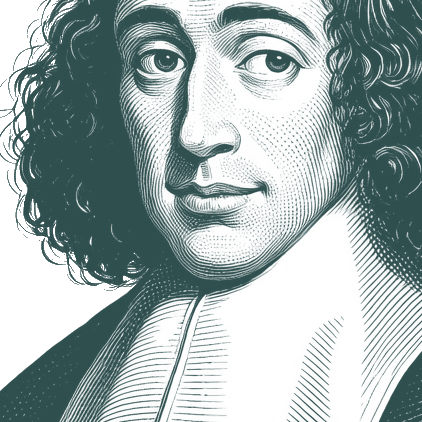
Man can, indeed, act contrarily to the decrees of God, as far as they have been written like laws in the minds of ourselves or the prophets, but agai… - Benedictus de Spinoza
""
Man can, indeed, act contrarily to the decrees of God, as far as they have been written like laws in the minds of ourselves or the prophets, but against that eternal decree of God, which is written in universal nature, and has regard to the course of nature as a whole, he can do nothing.
Benedictus de Spinoza (24 November 1632 – 21 February 1677) was a social and metaphysical philosopher known for the elaborate development of his monist philosophy, which has become known as Spinozism. Controversy regarding his ideas led to his excommunication from the Jewish community of his native Amsterdam. He was named Baruch ("blessed" in Hebrew) Spinoza by his synagogue elders and known as Bento de Spinoza or Bento d'Espiñoza, but afterwards used the name Benedictus ("blessed" in Latin) de Spinoza.
Native Name:
בָּרוּךְ שְׂפִּינוֹזָה
•
Benedito de Espinosa
Alternative Names:
Benedict de Spinoza
•
Baruch de Espinosa
•
Barukh Shpinozah
•
Benoît de Spinoza
•
Sbīnūzā
•
Ispīnūzā
•
Barukh Spinoza
•
Bento de Espinosa
•
Baruch d' Espinoza
•
Shpinozah
•
Baruch de Spinoza
•
Spinoza
•
Benoit de Spinoza
•
Benedictus De Spinoza
•
Benedictus Spinoza
•
Baruch Spinoza
•
Baruch Benedictus de Spinoza
But in his search for the divine, Spinoza delved down far below the roots of the Jewish religion. Deep in the depths of his own soul, he discovered the wellspring of the world, the secret source that sustained all things. Spinoza basked in the waters of this sacred spring until they saturated his whole being.
...But when it comes to the subject of the arts, Spinoza is oddly reticent. His failure to consider the aesthetic response—surely a profound facet of human experience—is all the stranger when one compares him, again, to Plato who directs as much conflicted pondering to the arts, particularly to poetry, as to erotic love.
Works in ChatGPT, Claude, or Any AI
Add semantic quote search to your AI assistant via MCP. One command setup.
I believe we can guess at the first time Einstein read Baruch Spinoza's Ethics (Ethica Ordinae Geometrico Demonstrata), a system constructed on the Euclidean model of deductions from propositions. Soon after getting his first real job at the patent office, Einstein joined with two friends to form a discussion circle, meeting once or twice a week in what they called, with gallows humor, the Akademie Olympia. We know the list of books they read and discussed. High among them, reportedly at Einstein's suggestion, was Spinoza's Ethics, which he read afterwards several times more. Even when his sister Maja joined him in Princeton in later life and was confined to bed by an illness, he thought that reading a good book to her would help, and chose Spinoza's Ethics for that purpose. By that time Spinoza's work and life had long been important to Einstein. He had written an introduction to a biography of Spinoza (by his son-in-law, Rudolf Kayser, 1946); he had contributed to the Spinoza Dictionary (1951); he had referred to Spinoza in many of his letters; and he even had composed a poem in Spinoza's honor. He admired Spinoza for his independence of mind, his deterministic philosophical outlook, his skepticism about organized religion and orthodoxy – which had resulted in his excommunication from his synagogue in 1656 – and even for his ascetic preference, which compelled him to remain in poverty and solitude to live in a sort of spiritual ecstasy, instead of accepting a professorship at the University of Heidelberg.