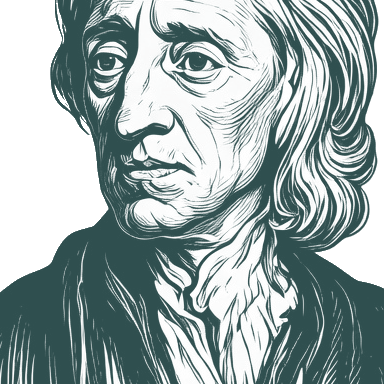
John Locke (29 August 1632 – 28 October 1704) was an influential English philosopher and social contract theorist. He developed an alternative to the Hobbesian state of nature and asserted a government could be good only if it received the consent of the governed and protected the natural rights of life, liberty, and estate. If such a consent was not achieved, Locke argued in favour of a right of rebellion, which he referred to as an "appeal to heaven".
Biography information from
Wikiquote·
Portrait adapted from
Wikimedia Commons, Godfrey Kneller (Public domain / CC0)
You have not that power you ought to have over him, till he comes to be more afraid of offending so good a friend than of losing some part of his future expectation.
If we will disbelieve everything, because we cannot certainly know all things, we shall do muchwhat as wisely as he who would not use his legs, but sit still and perish, because he had no wings to fly.
"Shall we suffer a Pagan to deal and trade with us, and shall we not suffer him to pray unto and worship God? If we allow the Jews to have private houses and dwellings amongst us, why should we not allow them to have synagogues? Is their doctrine more false, their worship more abominable, or is the civil peace more endangered by their meeting in public than in their private houses? But if these things may be granted to Jews and Pagans, surely the condition of any Christians ought not to be worse than theirs in a Christian commonwealth.
You will say, perhaps: "Yes, it ought to be; because they are more inclinable to factions, tumults, and civil wars." I answer: Is this the fault of the Christian religion? If it be so, truly the Christian religion is the worst of all religions and ought neither to be embraced by any particular person, nor tolerated by any commonwealth. For if this be the genius, this the nature of the Christian religion, to be turbulent and destructive to the civil peace, that Church itself which the magistrate indulges will not always be innocent."