That by the decrees and volitions, and consequently the providence of God, Scripture (as I will prove by Scriptural examples) means nothing but Natur… - Benedictus de Spinoza
""
That by the decrees and volitions, and consequently the providence of God, Scripture (as I will prove by Scriptural examples) means nothing but Nature's order following necessarily from her eternal laws.
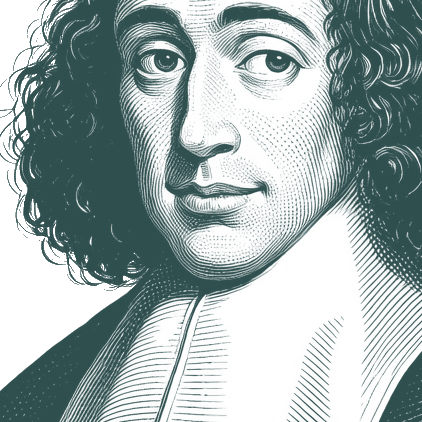
Benedictus de Spinoza (24 November 1632 – 21 February 1677) was a social and metaphysical philosopher known for the elaborate development of his monist philosophy, which has become known as Spinozism. Controversy regarding his ideas led to his excommunication from the Jewish community of his native Amsterdam. He was named Baruch ("blessed" in Hebrew) Spinoza by his synagogue elders and known as Bento de Spinoza or Bento d'Espiñoza, but afterwards used the name Benedictus ("blessed" in Latin) de Spinoza.
Native Name:
בָּרוּךְ שְׂפִּינוֹזָה
•
Benedito de Espinosa
Alternative Names:
Benedict de Spinoza
•
Baruch de Espinosa
•
Barukh Shpinozah
•
Benoît de Spinoza
•
Sbīnūzā
•
Ispīnūzā
•
Barukh Spinoza
•
Bento de Espinosa
•
Baruch d' Espinoza
•
Shpinozah
•
Baruch de Spinoza
•
Spinoza
•
Benoit de Spinoza
•
Benedictus De Spinoza
•
Benedictus Spinoza
•
Baruch Spinoza
•
Baruch Benedictus de Spinoza
الإنسان الحر لا يفكر في الموت إلا أقل القليل؛ فحكمته تسوقه إلى إمعان التفكير في الحياة، لا الموت.
It is a quality of Spinoza that a few pages by him can teach us whether we are his disciples, whereas big interpretive works have been written about him based on the most erudite misunderstandings. For to think like him does not mean to adopt a system but just to think. It delights me that the one thinker I approached in my childhood and almost adored now meets me once again, and as the philosopher of psychoanalysis. Think far enough, correctly enough on any point at all and you hit upon him; you meet him waiting for you, standing ready at the side of the road.
Go Premium
Support Quotewise while enjoying an ad-free experience and premium features.
In affirming that "what is true is the sign of itself and of what is false", Spinoza avoided any problematic which depended on a "criterion of truth ". If you claim to judge the truth of something by some "criterion", you face the problem of the criterion of this criterion -- since it also must be true -- and so on to infinity. Whether the criterion is external (relation of adequacy between mind and thing, in the Aristotelian tradition) or internal (Cartesian self-evidence), in either case the criterion can be rejected: for it only represents a form of Jurisdiction, a Judge to authenticate and guarantee the validity of what is True. And at the same time Spinoza avoids the temptation of talking about the Truth: as a good nominalist (nominalism, as Marx recognized, could then be the antechamber of materialism) Spinoza only talks about what is "true". In fact the idea of Truth and the idea of the Jurisdiction of a Criterion always go together, because the function of the criterion is to identify the Truth of what is true. Once he has set aside the (idealist) temptations of a theory of knowledge, Spinoza then says that "what is true" "identifies itself", not as a Presence but as a Product, in the double sense of the term "product" (result of the work of a process which "discovers" it), as it emerges in its own production. Now this position is not unrelated to the "criterion of practice", a major thesis of Marxist philosophy: for this Marxist "criterion" is not exterior but interior to practice, and since this practice is a process (Lenin insisted on this: practice is not an absolute "criterion" -- only the process is conclusive) the criterion is no form of Jurisdiction; items of knowledge [connaissances ] emerge in the process of their production. There again, by the contrast between them, Spinoza allows us to perceive Hegel's mistake.