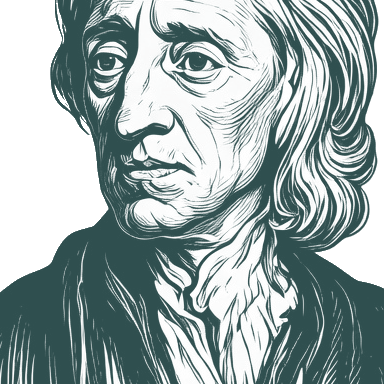
God gave the world to men in common; but since he gave it them for their benefit, and the greatest conveniencies of life they were capable to draw fr… - John Locke
""
God gave the world to men in common; but since he gave it them for their benefit, and the greatest conveniencies of life they were capable to draw from it, it cannot be supposed he meant it should always remain common and uncultivated.
John Locke (29 August 1632 – 28 October 1704) was an influential English philosopher and social contract theorist. He developed an alternative to the Hobbesian state of nature and asserted a government could be good only if it received the consent of the governed and protected the natural rights of life, liberty, and estate. If such a consent was not achieved, Locke argued in favour of a right of rebellion, which he referred to as an "appeal to heaven".
Biography information from
Wikiquote·
Portrait adapted from
Wikimedia Commons, Godfrey Kneller (Public domain / CC0)
Every man carries about him a touchstone, if he will make use of it, to distinguish substantial gold from superficial glitterings, truth from appearances. And indeed the use and benefit of this touchstone, which is natural reason, is spoiled and lost only by assumed prejudices, overweening presumption, and narrowing our minds.
For it will be very difficult to persuade men of sense that he who with dry eyes and satisfaction of mind can deliver his brother to the executioner to be burnt alive, does sincerely and heartily concern himself to save that brother from the flames of hell in the world to come.
Go Premium
Support Quotewise while enjoying an ad-free experience and premium features.
flatter princes with an opinion, that they have a divine right to absolute power, let the laws by which they are constituted and are to govern, and the conditions under which they enter upon their authority, be what they will ; and their engagements to observe them ever so well ratified by solemn oaths and promises.