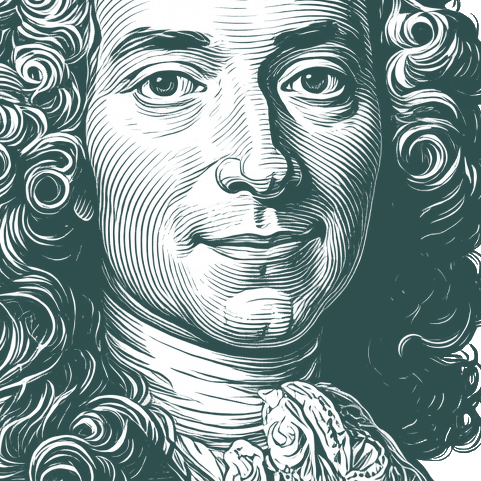
François-Marie Arouet (21 November 169430 May 1778), known by his nom de plume Voltaire, was a French Enlightenment writer, philosopher (philosophe), satirist, and historian. Famous for his wit and his criticism of Christianity (especially of the Roman Catholic Church) and of slavery, Voltaire was an advocate of freedom of speech, freedom of religion, and separation of church and state. Voltaire was a versatile and prolific writer, producing works in almost every literary form, including plays, poems, novels, essays, histories, and even scientific expositions. He wrote more than 20,000 letters and 2,000 books and pamphlets. Voltaire was one of the first authors to become renowned and commercially successful internationally. He was an outspoken advocate of civil liberties and was at constant risk from the strict censorship laws of the Catholic French monarchy. His polemics witheringly satirized intolerance and religious dogma, as well as the French institutions of his day. His best-known work and magnum opus, Candide, is a novella that comments on, criticizes, and ridicules many events, thinkers and philosophies of his time, most notably Gottfried Leibniz and his belief that our world is of necessity the "best of all possible worlds".
Biography information from
Wikipedia·
Portrait adapted from
Wikimedia Commons, Nicolas de Largillière (Public domain / CC0)
Also Known As
Pen Names:
Bénédictin
Alternative Names:
Dictador de letras
•
François-Marie Arouet
•
François Marie Arouet
•
Benedictina
You must have the Devil in you to succeed in any of the arts
Answer me, you who believe that animals are only machines. Has nature arranged for this animal to have all the machinery of feelings only in order for it not to have any at all?
PREMIUM FEATURE
Advanced Search Filters
Filter search results by source, date, and more with our premium search tools.
Virtue supposes liberty, as the carrying of a burden supposes active force. Under coercion there is no virtue, and without virtue there is no religion. Make a slave of me, and I shall be no better for it. Even the sovereign has no right to use coercion to lead men to religion, which by its nature supposes choice and liberty. My thought is no more subject to authority than is sickness or health.