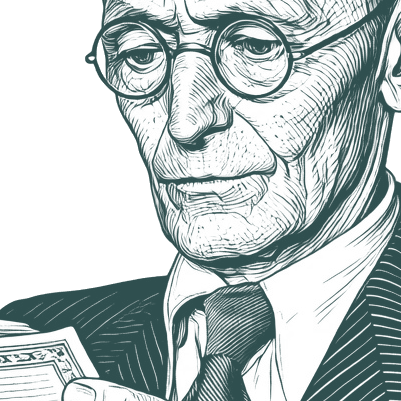
Of the many monks who had thronged the church, the dormitories and study-rooms, there were two, remarked by all, whom all were watching - Abbot Danie… - Hermann Hesse
""
Of the many monks who had thronged the church, the dormitories and study-rooms, there were two, remarked by all, whom all were watching - Abbot Daniel and the teaching novice, Narziss, only recently entered in the novitiate, yet already, against all tradition, and because of his exceptional gifts, employed, in Greek especially, as a teacher. These two, the novice and the abbot, were respected and heeded by all the house. They were watched and aroused curiosity, admired and envied, slandered in secret. Ch. I
Hermann Karl Hesse (2 July 1877 – 9 August 1962) was a German-Swiss poet, novelist, and painter. In 1946, he received the Nobel Prize in Literature. His most famous works include Steppenwolf, Siddhartha, and The Glass Bead Game (also known as Magister Ludi) all of which explore an individual's search for spirituality.
Fate and character are different names for the same idea.
For me, trees have always been the most penetrating preachers. I revere them when they live in tribes and families, in forests and groves. And even more I revere them when they stand alone. They are like lonely persons. Not like hermits who have stolen away out of some weakness, but like great, solitary men, like Beethoven and Nietzsche. In their highest boughs the world rustles, their roots rest in infinity; but they do not lose themselves there, they struggle with all the force of their lives for one thing only: to fulfil themselves according to their own laws, to build up their own form, to represent themselves. Nothing is holier, nothing is more exemplary than a beautiful, strong tree. When a tree is cut down and reveals its naked death-wound to the sun, one can read its whole history in the luminous, inscribed disk of its trunk: in the rings of its years, its scars, all the struggle, all the suffering, all the sickness, all the happiness and prosperity stand truly written, the narrow years and the luxurious years, the attacks withstood, the storms endured. And every young farmboy knows that the hardest and noblest wood has the narrowest rings, that high on the mountains and in continuing danger the most indestructible, the strongest, the ideal trees grow.
Works in ChatGPT, Claude, or Any AI
Add semantic quote search to your AI assistant via MCP. One command setup.
Art was a union of the father and mother worlds, of mind and blood. It might start in utter sensuality and lead to total abstraction; then again it might originate in pure concept and end in bleeding flesh. Any work of art that was truly sublime, not just a good juggler's trick; that was filled with the eternal secret, like the master's madonna; every obviously genuine work of art had this dangerous, smiling double face, was male-female, a merging of instinct and pure spirituality.