For many years I did not dare look into a Latin author or at anything which evoked an image of Italy. If this happened by chance, I suffered agonies.… - Benedictus de Spinoza
""
For many years I did not dare look into a Latin author or at anything which evoked an image of Italy. If this happened by chance, I suffered agonies. Herder often used to say mockingly that I had learned all my Latin from Spinoza, for that was the only Latin book he had ever seen me reading. He did not realize how carefully I had to guard myself against the classics, and that it was sheer anxiety which drove me to take refuge in the abstractions of Spinoza. [Original in German: Schon einige Jahre her durft' ich keinen lateinischen Autor ansehen, nichts betrachten, was mir ein Bild Italiens erneute. Geschah es zufällig, so erduldete ich die entsetzlichsten Schmerzen. Herder spottete oft über mich, daß ich all mein Latein aus dem Spinoza lerne, denn er hatte bemerkt, daß dies das einzige lateinische Buch war, das ich las; er wußte aber nicht, wie sehr ich mich vor den Alten hüten mußte, wie ich mich in jene abstrusen Allgemeinheiten nur ängstlich flüchtete.]
English
Collect this quote
About
Benedictus de Spinoza
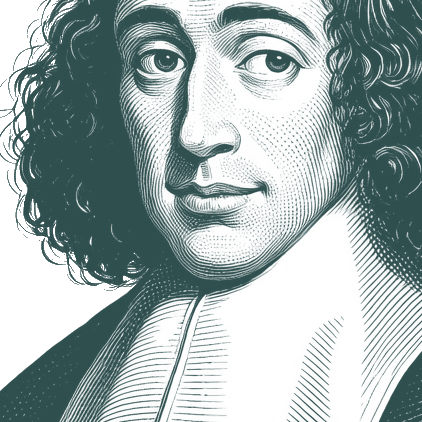
Benedictus de Spinoza (24 November 1632 – 21 February 1677) was a social and metaphysical philosopher known for the elaborate development of his monist philosophy, which has become known as Spinozism. Controversy regarding his ideas led to his excommunication from the Jewish community of his native Amsterdam. He was named Baruch ("blessed" in Hebrew) Spinoza by his synagogue elders and known as Bento de Spinoza or Bento d'Espiñoza, but afterwards used the name Benedictus ("blessed" in Latin) de Spinoza.
Native Name:
בָּרוּךְ שְׂפִּינוֹזָה
•
Benedito de Espinosa
Alternative Names:
Benedict de Spinoza
•
Baruch de Espinosa
•
Barukh Shpinozah
•
Benoît de Spinoza
•
Sbīnūzā
•
Ispīnūzā
•
Barukh Spinoza
•
Bento de Espinosa
•
Baruch d' Espinoza
•
Shpinozah
•
Baruch de Spinoza
•
Spinoza
•
Benoit de Spinoza
•
Benedictus De Spinoza
•
Benedictus Spinoza
•
Baruch Spinoza
•
Baruch Benedictus de Spinoza
After man has persuaded himself that all things which exist are made for him, he must in everything adjudge that to be of the greatest importance which is most useful to him, and he must esteem that to be of surpassing worth by which he is most beneficially affected. In this way he is compelled to form those notions by which he explains nature; such, for instance, as good, evil, order, confusion, heat, cold, beauty, and deformity, etc.; and because he supposes himself to be free, notions like those of praise and blame, sin and merit, have arisen.
In the year 1888, before leaving the Normal School to face the experiences of actual life, he wrote Credo quia verum. This is a remarkable document, a spiritual testament, a moral and philosophical confession. It remains unpublished, but a friend of Rolland's youth assures us that it contains the essential elements of his untrammeled outlook on the world. Conceived in the Spinozist spirit, based not upon "Cogito ergo sum" but upon "Cogito ergo est," it builds up the world, and thereon establishes its god.
Spinoza helps me to see myself objectively. This makes life bearable even in experiencing suffering; and with the teachings from the Ethics the world is perceived as manageable.