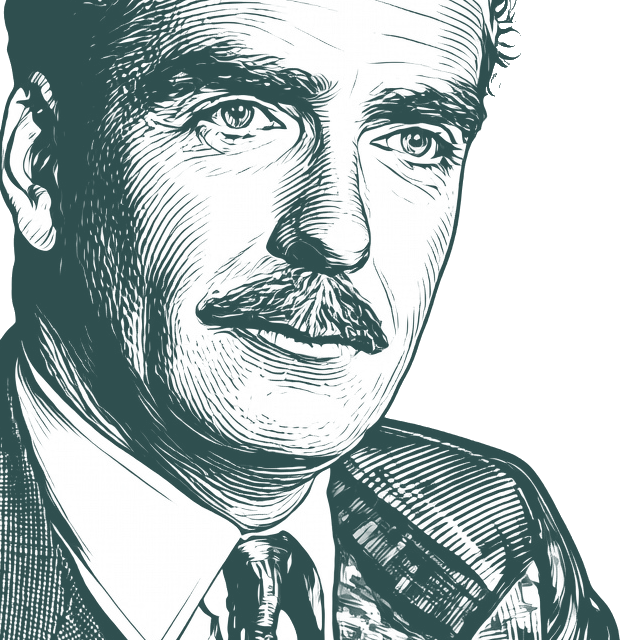
It is with the great democracies of Europe and America that our natural affinities must lie. We must stand by our conception of international order w… - Anthony Eden
""
It is with the great democracies of Europe and America that our natural affinities must lie. We must stand by our conception of international order without which there can be no lasting peace. Nor must we for one instant weaken in our own faith in Parliamentary government and individual liberty. These are the things that count. They are the fundamental articles of our faith and our contribution to what survives of civilisation today. However anxious the future, the need for unity and forbearance becomes not less but greater. In that spirit let us approach the future.
Robert Anthony Eden, 1st Earl of Avon, KG, MC, PC (12 June 1897 – 14 January 1977) was a British Conservative politician who served three periods as Foreign Secretary and then a short term as Prime Minister of the United Kingdom from 1955 to 1957. He served as British Foreign Secretary under Prime Minister Winston Churchill during World War II, having previously resigned the office in opposition of Prime Minister Neville Chamberlain's appeasement of Nazi Germany. His brief premiership ended after he ordered an invasion of Egypt alongside France and Israel during the Suez Crisis, leading to international condemnation of the UK and an acceleration of the decolonization of the British Empire.
Portrait adapted from
Wikimedia Commons, Walter Stoneman (Public domain / CC0)
Also Known As
Birth Name:
Robert Anthony Eden
Alternative Names:
Robert Anthony Eden, 1st Earl of Avon
•
Sir Anthony Eden
•
Lord Avon
•
Earl of Avon
The British public is not anti-German at present but it would be opposed to any country which showed the intention of breaking the peace. A great many people in England think that French rigidity has helped Hitler's rise. People in England are neither pro-French nor anti-German. If they were finally convinced that Germany intended to break the peace, they would align themselves accordingly.
I have attempted to state our reasons for refusing to take isolated action. Yet we have to face the facts, and we shall face them. We have to admit the failure of the League in this, and we have to admit our own disappointment; and it may surprise the hon. Gentleman if I tell him that my disappointment is at least as great as his. Where I differ from him is that I say that, if success is collective, failure must be collective, too. Without doubt a blow has been struck at the structure of the League and the conception of collective security... What of the immediate future? It is clear that the League must go on; in a modern world it is absolutely indispensable to the organisation of international affairs. That is clear.
Try QuoteGPT
Chat naturally about what you need. Each answer links back to real quotes with citations.
I thought that the essential factor we have to remember in deciding on our plans and policy for the future is that in the German character the unquestioned authority of the State is what counts for most. The average German is the instrument of the State to an extent which is incomprehensible to us. He belongs to the State, and the State does not belong to him. I see no signs of that in this country, and I believe that the authority we enjoy in the world to-day is precisely because we represent the complete antithesis of the German State conception. This acceptance of the State, since the days of the Prussians, has made Germans ready to aid any leader who wants to guide them into fields of aggression. With the German, the larger the State the more remote and the more majestic is the authority he is prepared to follow into battle or wherever he is led. Germans believe that it is the destiny of their race to be the dominating Power in Europe; that is far more important to them than either the freedom of the individual or the dignity of any particular man or woman. Unless we are seized of that we do not understand the foundation on which Nazi doctrine was so easily superimposed. It was acceptable to the average German because it expressed in aggressive forms the belief which the average German has had for 200 years or more.