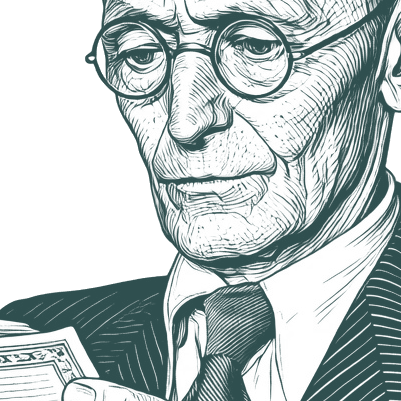
It was fortunate that love did not need words; or else it would be full of misunderstanding and foolishness. - Hermann Hesse

" "

It was fortunate that love did not need words; or else it would be full of misunderstanding and foolishness.

English
Collect this quote

About Hermann Hesse

Hermann Karl Hesse (2 July 1877 – 9 August 1962) was a German-Swiss poet, novelist, and painter. In 1946, he received the Nobel Prize in Literature. His most famous works include Steppenwolf, Siddhartha, and The Glass Bead Game (also known as Magister Ludi) all of which explore an individual's search for spirituality.

Biography information from Wikiquote

Also Known As

Native Name: Hermann Karl Hesse
Alternative Names: Hh. Hesse
Limited Time Offer

Premium members can get their quote collection automatically imported into their Quotewise collections.

Related quotes. More quotes will automatically load as you scroll down, or you can use the load more buttons.

Additional quotes by Hermann Hesse

The bourgeois prefers comfort to pleasure, convenience to liberty, and a pleasant temperature to the deathly inner consuming fire

Teachers dread nothing so much as unusual characteristics in precocious boys during the initial stages of their adolescence. A certain streak of genius makes an ominous impression on them, for there exists a deep gulf between genius and the teaching profession. Anyone with a touch of genius seems to his teachers a freak from the very first. As far as teachers are concerned, they define young geniuses as those who are bad, disrespectful, smoke at fourteen, fall in love at fifteen, can be found at sixteen hanging out in bars, read forbidden books, write scandalous essays, occasionally stare down a teacher in class, are marked in the attendance book as rebels, and are budding candidates for room-arrest. A schoolmaster will prefer to have a couple of dumbheads in his class than a single genius, and if you regard it objectively, he is of course right. His task is not to produce extravagant intellects but good Latinists, arithmeticians and sober decent folk. The question of who suffers more acutely at the other's hands - the teacher at the boy's, or vice versa - who is more of a tyrant, more of a tormentor, and who profanes parts of the other's soul, student or teacher, is something you cannot examine without remembering your own youth in anger and shame. yet that's not what concerns us here. We have the consolation that among true geniuses the wounds almost always heal. As their personalities develop, they create their art in spite of school. Once dead, and enveloped by the comfortable nimbus of remoteness, they are paraded by the schoolmasters before other generations of students as showpieces and noble examples. Thus the struggle between rule and spirit repeats itself year after year from school to school. The authorities go to infinite pains to nip the few profound or more valuable intellects in the bud. And time and again the ones who are detested by their teachers are frequently punished, the runaways and those expelled, are the ones who afterwards add to society's

PREMIUM FEATURE
Advanced Search Filters

Filter search results by source, date, and more with our premium search tools.

"When a person seeks," Siddhartha said, "it can easily happen that his eye sees only the thing he is seeking; he is incapable of finding anything, of allowing anything to enter into him, because he is always thinking only of what he is looking for, because he has a goal, because he is possessed by his goal. Seeking means having a goal. Finding means being free, being open, having no goal. You, Venerable One, are perhaps indeed a seeker, for, striving to reach your goal, you overlook many things that lie close before your eyes."

Loading...