had not the invention of money, and the tacit agreement of men to put a value on it, introduced (by consent) larger possessions, and a right to them;… - John Locke
""
had not the invention of money, and the tacit agreement of men to put a value on it, introduced (by consent) larger possessions, and a right to them; which, how it has done, I shall by and by show more at large.
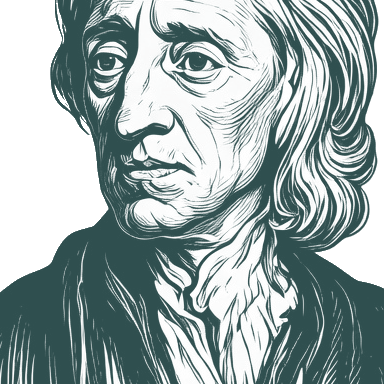
John Locke (29 August 1632 – 28 October 1704) was an influential English philosopher and social contract theorist. He developed an alternative to the Hobbesian state of nature and asserted a government could be good only if it received the consent of the governed and protected the natural rights of life, liberty, and estate. If such a consent was not achieved, Locke argued in favour of a right of rebellion, which he referred to as an "appeal to heaven".
Biography information from
Wikiquote·
Portrait adapted from
Wikimedia Commons, Godfrey Kneller (Public domain / CC0)
I am sure the principal end why we are to get knowledge here, is to make use of it for the benefit of ourselves and others in this world; but if by gaining it we destroy our health, we labour for a thing that will be useless in our hands, and if by harnessing our bodies (though with a design to render ourselves more useful)we deprive ourselves of the abilities and opportunities of doing that good we might have done with a meaner talent, which God thought sufficient for us by having denied us the strength to iprove it to that pitch which men of higher constitutions can attain to, we rob God of so much service, and our neighbor of all that help, which, in a state of health, with moderate knowledge, we might have been able to perform. He that sinks his vessel by overloading it, though it be with gold and silver and precious stones, will gives his owner but an ill account of his voyage.
For it will be very difficult to persuade men of sense that he who with dry eyes and satisfaction of mind can deliver his brother to the executioner to be burnt alive, does sincerely and heartily concern himself to save that brother from the flames of hell in the world to come.
The state of nature has a law of nature to govern it, which obliges every one: and reason, which is that law, teaches all mankind, who will but consult it, that being all equal and independent, no one ought to harm another in his life, health, liberty, or possessions: