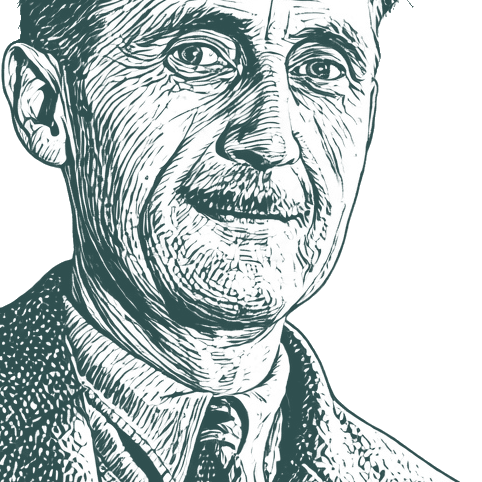
Both men were the spiritual children of Voltaire, both had an ironical, sceptical view of life, and a native pessimism overlaid by gaiety; both knew … - George Orwell
""
Both men were the spiritual children of Voltaire, both had an ironical, sceptical view of life, and a native pessimism overlaid by gaiety; both knew that the existing social order is a swindle and its cherished beliefs mostly delusions.
George Orwell (25 June 1903 – 21 January 1950) was the pen name of British novelist, essayist, and journalist Eric Arthur Blair, whose work is characterised by lucid prose, awareness of social injustice, opposition to totalitarianism, and strong support of democratic socialism.
Biography information from
Wikiquote·
Portrait adapted from
Wikimedia Commons, Cassowary Colorizations (CC BY)
Also Known As
Pen Names:
John Freeman
Birth Name:
Eric Arthur Blair
Alternative Names:
Orwell
•
Eric Blair
•
P. S. Burton
In the nineteenth century some parts of the world were unexplored, but there was almost no restriction on travel. Up to 1914 you did not need a passport for any country except Russia. The European emigrant, if he could scrape together a few pounds for the passage, simply set sail for America or Australia, and when he got there no questions were asked. In the eighteenth century it had been quite normal and safe to travel in a country with which your own country was at war.
The enemy of the moment always represented absolute evil, and it followed that any past or future agreement with him was impossible.
I have never visited Russia and my knowledge of it consists only of what can be learned by reading books and newspapers. Even if I had the power, I would not wish to interfere in Soviet domestic affairs: I would not condemn Stalin and his associates merely for their barbaric and undemocratic methods. It is quite possible that, even with the best intentions, they could not have acted otherwise under the conditions prevailing there. But on the other hand it was of the utmost importance to me that people in western Europe should see the Soviet regime for what it really was. Since 1930 I had seen little evidence that the USSR was progressing towards anything that one could truly call Socialism. On the contrary, I was struck by clear signs of its transformation into a hierarchical society, in which the rulers have no more reason to give up their power than any other ruling class. Moreover, the workers and intelligentsia in a country like England cannot understand that the USSR of today is altogether different from what it was in 1917. It is partly that they do not want to understand (i.e. they want to believe that, somewhere, a really Socialist country does actually exist), and partly that, being accustomed to comparative freedom and moderation in public life, totalitarianism is completely incomprehensible to them.