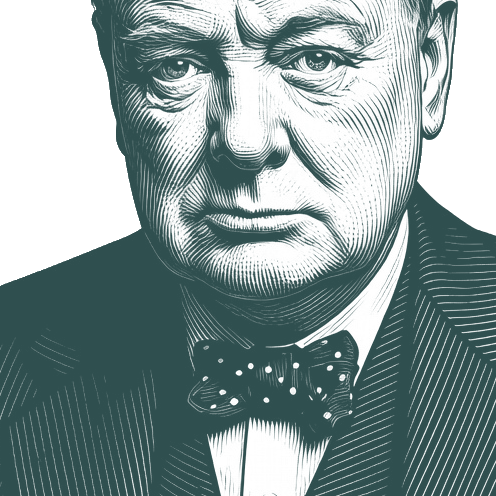
Sir Winston Leonard Spencer Churchill KG OM CH TD FRS PC (November 30, 1874 – January 24, 1965) was a British statesman who served as Prime Minister of the United Kingdom from 1940 to 1945, during the Second World War, and again from 1951 to 1955. Churchill was a Sandhurst-educated soldier, a Nobel Prize-winning writer and historian, a prolific painter, and one of the longest-serving politicians in British history. Apart from two years between 1922 and 1924, he was a Member of Parliament (MP) from 1900 to 1964 and represented a total of five constituencies. Ideologically an economic liberal and imperialist, he was for most of his career a member of the Conservative Party, which he led from 1940 to 1955, though he was a member of the Liberal Party from 1904 to 1924.
Biography information from
Wikiquote·
Portrait adapted from
Wikimedia Commons, Yousuf Karsh (Public domain / CC0)
Also Known As
Birth Name:
Winston Leonard Spencer Churchill
Also Known As:The pug•The Old Lion
Alternative Names:
Winston Spencer Churchill
•
Charles Maurin
•
David Winter
•
The Honourable Sir Winston Spencer Churchill
•
Colonel Warden
•
Sir Winston Leonard Spencer Churchill
•
Sir Leonard Spencer
•
Sir Winston Churchill
•
Sir Winston Spencer Churchill
•
Mr Green
•
The Right Honourable Sir Winston Spencer Churchill
•
The Right Honourable Sir Winston Leonard Spencer Churchill
•
The Right Honourable Sir Winston Churchill
•
Churchill
•
Winston S. Churchill
•
Winston Leonard Spencer-Churchill
•
Sir Winston Leonard Spencer-Churchill
[Christopher Soames, Churchill's future son-in-law, remembered] Churchill showing him around Chartwell Farm [around 1946]. When they came to the piggery Churchill scratched one of the pigs and said: I am fond of pigs. Dogs look up to us. Cats look down on us. Pigs treat us as equals.