If anyone maintain that men ought to be compelled by fire and sword to profess certain doctrines, and conform to this or that exterior worship, witho… - John Locke
""
If anyone maintain that men ought to be compelled by fire and sword to profess certain doctrines, and conform to this or that exterior worship, without any regard had unto their morals; if anyone endeavour to convert those that are erroneous unto the faith, by forcing them to profess things that they do not believe and allowing them to practise things that the Gospel does not permit, it cannot be doubted indeed but such a one is desirous to have a numerous assembly joined in the same profession with himself; but that he principally intends by those means to compose a truly Christian Church is altogether incredible.
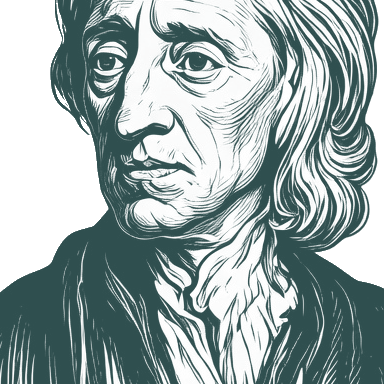
John Locke (29 August 1632 – 28 October 1704) was an influential English philosopher and social contract theorist. He developed an alternative to the Hobbesian state of nature and asserted a government could be good only if it received the consent of the governed and protected the natural rights of life, liberty, and estate. If such a consent was not achieved, Locke argued in favour of a right of rebellion, which he referred to as an "appeal to heaven".
Biography information from
Wikiquote·
Portrait adapted from
Wikimedia Commons, Godfrey Kneller (Public domain / CC0)
Dominion of life and death, making war, and concluding peace, p. 13. Adam and the patriarchs had absolute power of life and death,
There is nobody in the commonwealth of learning who does not profess himself a lover of truth: and there is not a rational creature that would not take it amiss to be thought otherwise of. And yet, for all this, one may truly say, that there are very few lovers of truth, for truth’s sake, even amongst those who persuade themselves that they are so. How a man may know whether he be so in earnest, is worth inquiry: and I think there is one unerring mark of it, viz. The not entertaining any proposition with greater assurance than the proofs it is built upon will warrant. Whoever goes beyond this measure of assent, it is plain, receives not the truth in the love of it; loves not truth for truth’s sake, but for some other bye-end.
Works in ChatGPT, Claude, or Any AI
Add semantic quote search to your AI assistant via MCP. One command setup.
There cannot be a greater rudeness, than to interrupt another in the current of his discourse... To which, if there be added, as is usual, a correcting of any mistake, or a contradiction of what has been said, it is a mark of yet greater pride and self-conceitedness, when we thus intrude our selves for teachers, and take upon us either to set another right in his story, or shew the mistakes of his judgement.