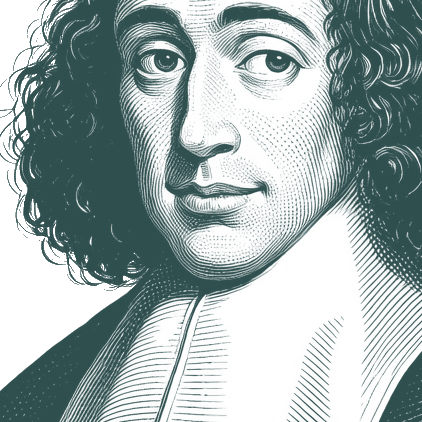
My son is taking a course in philosophy, and last night we were looking at something by Spinoza and there was the most childish reasoning! There were… - Benedictus de Spinoza
""
My son is taking a course in philosophy, and last night we were looking at something by Spinoza and there was the most childish reasoning! There were all these attributes, and Substances, and all this meaningless chewing around, and we started to laugh. Now how could we do that? Here's this great Dutch philosopher, and we're laughing at him. It's because there's no excuse for it! In the same period there was Newton, there was Harvey studying the circulation of the blood, there were people with methods of analysis by which progress was being made! You can take every one of Spinoza's propositions, and take the contrary propositions, and look at the world and you can't tell which is right.
English
Collect this quote
About
Benedictus de Spinoza
Benedictus de Spinoza (24 November 1632 – 21 February 1677) was a social and metaphysical philosopher known for the elaborate development of his monist philosophy, which has become known as Spinozism. Controversy regarding his ideas led to his excommunication from the Jewish community of his native Amsterdam. He was named Baruch ("blessed" in Hebrew) Spinoza by his synagogue elders and known as Bento de Spinoza or Bento d'Espiñoza, but afterwards used the name Benedictus ("blessed" in Latin) de Spinoza.
Native Name:
בָּרוּךְ שְׂפִּינוֹזָה
•
Benedito de Espinosa
Alternative Names:
Benedict de Spinoza
•
Baruch de Espinosa
•
Barukh Shpinozah
•
Benoît de Spinoza
•
Sbīnūzā
•
Ispīnūzā
•
Barukh Spinoza
•
Bento de Espinosa
•
Baruch d' Espinoza
•
Shpinozah
•
Baruch de Spinoza
•
Spinoza
•
Benoit de Spinoza
•
Benedictus De Spinoza
•
Benedictus Spinoza
•
Baruch Spinoza
•
Baruch Benedictus de Spinoza
The philosopher John Toland, in the early 18th century, insisted that the terms 'Spinozism' and 'pantheism' are synonymous. Toland says that "Moses was, to be sure, a Pantheist, or, if you please, in more current terms, a Spinosist", while Spinoza's pantheism was taken for granted by Moses Mendelssohn, Gotthold Lessing and Friedrich Jacobi, in their famous Pantheismusstreit of 1785. More recently, this interpretation also appears in both the scholarly literature and popular representations of Spinoza's thought. In the recently published Cambridge Dictionary of Philosophy we read that "Spinoza is the most distinguished pantheist in Western philosophy". But the problem with calling Spinoza a 'pantheist' is that pantheism is still a kind of theism.
Schelling calls Spinoza "the first philosopher who found the concepts whereby all the following centuries have grasped and fixed the two extremities of our knowing mind." For Lessing and Herder philosophy and Spinozism were identical; and the same statement was also made by Hegel, the most comprehensive and systematic, as well as the most independent and firm, among the German philosophers, who did not attempt, like Leibnitz, Fichte or Schelling, to reshape again and again his original-philosophy. And Hegel also said, "either you have Spinozism or you have no philosophy!"
Limited Time Offer
Premium members can get their quote collection automatically imported into their Quotewise collections.