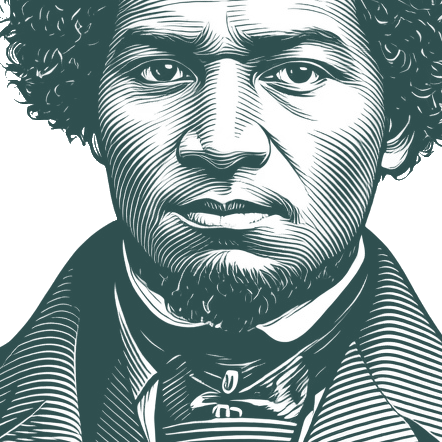
Europe and Africa are already here, and the Indian was here before either. He stands today between the two extremes of black and white, too proud to … - Frederick Douglass
""
Europe and Africa are already here, and the Indian was here before either. He stands today between the two extremes of black and white, too proud to claim fraternity with either, and yet too weak to withstand the power of either. Heretofore, the policy of our government has been governed by race pride, rather than by wisdom. Until recently, neither the Indian nor the negro has been treated as a part of the body politic. No attempt has been made to inspire either with a sentiment of patriotism, but the hearts of both races have been diligently sown with the dangerous seeds of discontent and hatred.
English
Collect this quote
About
Frederick Douglass
Frederick Douglass (c. February 1818 – 20 February 1895) was an American abolitionist, orator, author, editor, reformer, women's rights advocate, and statesman during the American Civil War. He was born a slave in Maryland, as Frederick Augustus Washington Bailey.
Biography information from
Wikiquote·
Portrait adapted from
Wikimedia Commons, Engraved by J.C. Buttre from a daguerreotype. (Public domain / CC0)
Also Known As
Birth Name:
Frederick Augustus Washington Bailey
Alternative Names:
Frederick Augustus Washington Baly
•
Fred Bailey
•
Freddie Bailey
Portrait from Wikimedia Commons. Credit: Engraved by J.C. Buttre from a daguerreotype.. Used under Public domain / CC0. Processed and styled by Quotewise.
Enhance Your Quote Experience
Enjoy ad-free browsing, unlimited collections, and advanced search features with Premium.
But giving the provisions the very worse construction, what does it amount to? I answer — It is a downright disability laid upon the slaveholding States; one which deprives those States of two-fifths of their natural basis of representation. A black man in a free State is worth just two-fifths more than a black man in a slave State, as a basis of political power under the Constitution. Therefore, instead of encouraging slavery, the Constitution encourages freedom by giving an increase of “two-fifths” of political power to free over slave States. So much for the three-fifths clause; taking it at is worst, it still leans to freedom, not slavery; for, be it remembered that the Constitution nowhere forbids a coloured man to vote.
The lesson taught at this point by human experience is simply this, that the man who will get up will be helped up; and the man who will not get up will be allowed to stay down. This rule may appear somewhat harsh, but in its general application and operation it is wise, just and beneficent. I know of no other rule which can be substituted for it without bringing social chaos. Personal independence is a virtue and it is the soul out of which comes the sturdiest manhood. But there can be no independence without a large share of self-dependence, and this virtue cannot be bestowed. It must be developed from within.
Unlimited Quote Collections
Organize your favorite quotes without limits. Create themed collections for every occasion with Premium.
I have shown that slavery is wicked—wicked, in that it violates the great law of liberty, written on every human heart—wicked, in that it violates the first command of the decalogue—wicked, in that it fosters the most disgusting licentiousness—wicked, in that it mars and defaces the image of God by cruel and barbarous inflictions—wicked, in that it contravenes the laws of eternal justice, and tramples in the dust all the humane and heavenly precepts of the New Testament.