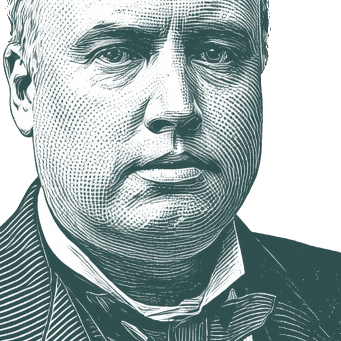
Robert Green Ingersoll (August 11, 1833 – July 21, 1899) was a lawyer, a Civil War veteran, political leader, and orator of the United States during the Golden Age of Freethought, noted for his broad range of culture and his defense of agnosticism. He was nicknamed "The Great Agnostic".
Biography information from
Wikiquote·
Portrait adapted from
Wikimedia Commons, Mathew Benjamin Brady / Levin Corbin Handy (Public domain / CC0)
Also Known As
Alternative Names:
Robert Ingersoll
•
The Great Agnostic
•
Robert G. Ingersoll
Portrait from Wikimedia Commons. Credit: Mathew Benjamin Brady / Levin Corbin Handy. Used under Public domain / CC0. Processed and styled by Quotewise.
Limited Time Offer
Premium members can get their quote collection automatically imported into their Quotewise collections.
After all, sympathy is genius. A man who really sympathizes with another understands him. A man who sympathizes with a religion, instantly sees the good that is in it, and the man who sympathizes with the right, sees the evil that a creed contains.
Is it necessary that Heaven should borrow its light from the glare of Hell? Infinite punishment is infinite cruelty, endless injustice, immortal meanness. To worship an eternal gaoler hardens, debases, and pollutes even the vilest soul. While there is one sad and breaking heart in the universe, no good being can be perfectly happy.
Unlimited Quote Collections
Organize your favorite quotes without limits. Create themed collections for every occasion with Premium.
The history of man is simply the history of slavery, of injustice and brutality, together with the means by which he has, through the dead and desolate years, slowly and painfully advanced. He has been the sport and prey of priest and king, the food of superstition and cruel might. Crowned force has governed ignorance through fear. Hypocrisy and tyranny — two vultures — have fed upon the liberties of man. From all these there has been, and is, but one means of escape — intellectual development. Upon the back of industry has been the whip. Upon the brain have been the fetters of superstition. Nothing has been left undone by the enemies of freedom. Every art and artifice, every cruelty and outrage has been practiced and perpetrated to destroy the rights of man. In this great struggle every crime has been rewarded and every virtue has been punished. Reading, writing, thinking and investigating have all been crimes.
Every science has been an outcast.
All the altars and all the thrones united to arrest the forward march of the human race. The king said that mankind must not work for themselves. The priest said that mankind must not think for themselves. One forged chains for the hands, the other for the soul. Under this infamous regime the eagle of the human intellect was for ages a slimy serpent of hypocrisy.
The human race was imprisoned. Through some of the prison bars came a few struggling rays of light. Against these bars Science pressed its pale and thoughtful face, wooed by the holy dawn of human advancement. Bar after bar was broken away. A few grand men escaped and devoted their lives to the liberation of their fellows.