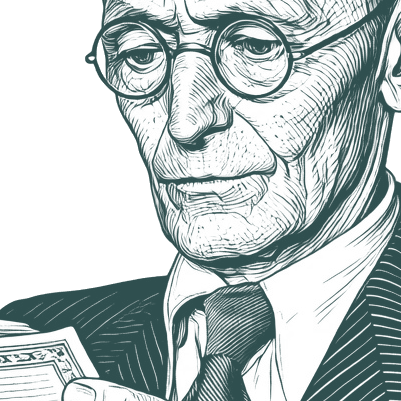
For the first time I understood Goethe’s laughter, the laughter of the immortals. It was a laughter without an object. It was simply light and lucidi… - Hermann Hesse
""
For the first time I understood Goethe’s laughter, the laughter of the immortals. It was a laughter without an object. It was simply light and lucidity. It was that which is left over when a true man has passed through all the sufferings, vices, mistakes, passions, and misunderstandings of men and got through to eternity and the world of space. And eternity was nothing else than the redemption of time, its return to innocence, so to speak, and its transformation again to space.
Hermann Karl Hesse (2 July 1877 – 9 August 1962) was a German-Swiss poet, novelist, and painter. In 1946, he received the Nobel Prize in Literature. His most famous works include Steppenwolf, Siddhartha, and The Glass Bead Game (also known as Magister Ludi) all of which explore an individual's search for spirituality.
"I shall no longer be instructed by the Yoga Veda or the Aharva Veda, or the ascetics, or any other doctrine whatsoever. I shall learn from myself, be a pupil of myself; I shall get to know myself, the mystery of Siddhartha." He looked around as if he were seeing the world for the first time.
The realms of day and night. Two different worlds coming from two opposite poles mingled during this time.
Go Premium
Support Quotewise while enjoying an ad-free experience and premium features.