She could not admit but that he had remarkable qualities, sometimes she thought that there was even in him a strange and unattractive greatness; it w… - William Somerset Maugham
""
She could not admit but that he had remarkable qualities, sometimes she thought that there was even in him a strange and unattractive greatness; it was curious then that she could not love him, but loved still a man whose worthlessness was now so clear to her.
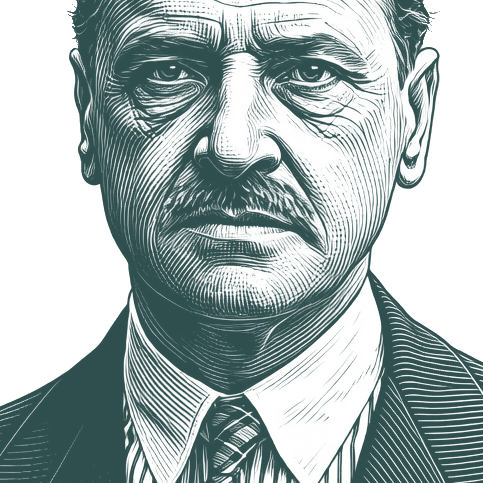
William Somerset Maugham (25 January 1874 – 16 December 1965) was an English playwright, novelist, and short story writer; often published as simply W. Somerset Maugham.
Biography information from
Wikiquote·
Portrait adapted from
Wikimedia Commons, Carl Van Vechten (1880 - 1964) (Public domain / CC0)
Also Known As
Alternative Names:
W. Somerset Maugham
•
Somerset Maugham
There are psychologists who think that consciousness accompanies brain processes and is determined by them but doesn't itself exert any influence on them. Something like the reflection of a tree in water; it couldn't exist without the tree, but it doesn't in any way affect he tree. I think it's all stuff and nonsense to say that there can be love without passion; when people say love can endure after passion is dead they're talking of something else, affection, kindliness, community of taste and interest, and habit . . . Of course there can be desire without love. Desire isn't passion. Desire is the natural consequence of the sexual instinct . . . That's why women are foolish to make a song and dance if their husbands have an occasional flutter when the time and place are propitious . . . what is sauce for the gander is sauce for the goose . . . Unless love is passion, it's not love, but something else; and passion thrives not on satisfaction but impediment . . . When passion seizes the heart it invents reasons that seem not only plausible but conclusive to prove that the world is well lost for love. It convinces you that honor is well sacrificed and that shame is a cheap price to pay. Passion is destructive . . . and if it doesn't destroy it dies. It may be then that one is faced with the desolation of knowing that one has wasted the years of one's life, that one's brought disgrace upon oneself, endured the frightful pang of jealousy, swallowed every bitter mortification, that one's expended all one's tenderness, poured out all the riches of one's soul on a poor drab, a fool, a peg on which one hung one's dreams, who wasn't worth a stick of chewing gum.
It is pleasure that lurks in the practice of every one of your virtues. Man performs actions because they are good for him, and when they are good for other people as well they are thought virtuous: if he finds pleasure in helping others he is benevolent; if he finds pleasure in working for society he is public-spirited; but it is for your private pleasure that you give twopence to a beggar as much as it is for my private pleasure that I drink another whiskey and soda. I, less of a humbug than you, neither applaud myself for my pleasure nor demand your admiration.
Try QuoteGPT
Chat naturally about what you need. Each answer links back to real quotes with citations.
Said in 1921. Quoted in The Guinness Dictionary of Sports Quotations (1990), p. 75