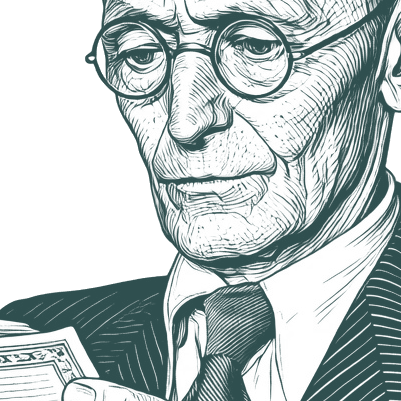
It was growing dark but there was still no light in any window. The tune, with its simple variations, was finished. There was silence....Then I heard… - Hermann Hesse
""
It was growing dark but there was still no light in any window. The tune, with its simple variations, was finished. There was silence....Then I heard a door being opened upstairs and soon I also heard footsteps on the stairs. The door of the house was opened and someone came out, and his walk was like his whistling, light and jolly, but steady, healthy and youthful. It was a very slim, hatless man, not very tall, who walked there. And now my feeling was changed to certainty. It was Leo; not only the Leo from the directory, it was Leo himself, our dear travelling companion and servant Leo, whose disappearance ten or more years ago had brought us so much sadness and confusion. I nearly addressed him in the moment of my initial joy and surprise. Then I only just remembered that I had also often heard him whistling during the journey to the East... the same strains of previous times, and yet how strangely different they sounded...! A feeling of sadness came over me like a stab in the heart: oh, how different everything had become since then, the sky, the air, the seasons, dreams, sleep, day and night! How greatly and terribly everything had changed for me when, through memory of the past alone, a whistle and the rhythm of a known step could affect me so deeply and give me so much pleasure and pain! p. 52
Hermann Karl Hesse (2 July 1877 – 9 August 1962) was a German-Swiss poet, novelist, and painter. In 1946, he received the Nobel Prize in Literature. His most famous works include Steppenwolf, Siddhartha, and The Glass Bead Game (also known as Magister Ludi) all of which explore an individual's search for spirituality.
Wenn wir einen Menschen hassen, so hassen wir in seinem Bild etwas, was in uns selber sitzt. Was nicht in uns selber ist, das regt uns nicht auf.
He saw mankind going through life in a childlike manner... which he loved but also despised.... He saw them toiling, saw them suffering, and becoming gray for the sake of things which seemed to him to be entirely unworthy of this price, for money, for little pleasures, for being slightly honoured....
Unlimited Quote Collections
Organize your favorite quotes without limits. Create themed collections for every occasion with Premium.
Man is not by any means of fixed and enduring form (this, in spite of suspicious to the contrary on the part of their wise men, was the ideal of the ancients). He is much more an experiment and a transition. He is nothing else than the narrow and perilous bridge between nature and spirit. His innermost destiny drives him on to the spirit and to God. His innermost longing draws him back to nature, and the mother. Between the two forces his life hangs tremulous and resolute.