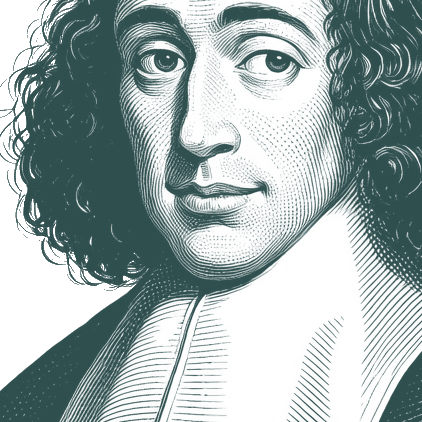
The latter [Descartes] had sharply divided nature into mind and matter, i.e., thinking and extended substance, and had also placed God and the world … - Benedictus de Spinoza
""
The latter [Descartes] had sharply divided nature into mind and matter, i.e., thinking and extended substance, and had also placed God and the world in complete opposition to each other; Spinoza also, so long as he was a Cartesian, taught all that in his “Cogitatis Metaphysicis,” c. 12, i. I., 1665. Only in his later years did he see the fundamental falseness of that double dualism; and accordingly his own philosophy principally consists of the indirect abolition of these two antitheses. Yet partly to avoid injuring his teacher, partly in order to be less offensive, he gave it a positive appearance by means of a strictly dogmatic form, although its content is chiefly negative. His identification of the world with God has also this negative significance alone. For to call the world God is not to explain it: it remains a riddle under the one name as under the other. But these two negative truths had value for their age, as for every age in which there still are conscious or unconscious Cartesians.
Benedictus de Spinoza (24 November 1632 – 21 February 1677) was a social and metaphysical philosopher known for the elaborate development of his monist philosophy, which has become known as Spinozism. Controversy regarding his ideas led to his excommunication from the Jewish community of his native Amsterdam. He was named Baruch ("blessed" in Hebrew) Spinoza by his synagogue elders and known as Bento de Spinoza or Bento d'Espiñoza, but afterwards used the name Benedictus ("blessed" in Latin) de Spinoza.
Native Name:
בָּרוּךְ שְׂפִּינוֹזָה
•
Benedito de Espinosa
Alternative Names:
Benedict de Spinoza
•
Baruch de Espinosa
•
Barukh Shpinozah
•
Benoît de Spinoza
•
Sbīnūzā
•
Ispīnūzā
•
Barukh Spinoza
•
Bento de Espinosa
•
Baruch d' Espinoza
•
Shpinozah
•
Baruch de Spinoza
•
Spinoza
•
Benoit de Spinoza
•
Benedictus De Spinoza
•
Benedictus Spinoza
•
Baruch Spinoza
•
Baruch Benedictus de Spinoza
With the judgment of the angels and the sentence of the saints, we anathematize, execrate, curse and cast out Baruch de Espinoza, the whole of the sacred community assenting, in presence of the sacred books with the six-hundred-and-thirteen precepts written therein, pronouncing against him the malediction wherewith Elisha cursed the children, and all the maledictions written in the Book of the Law. Let him be accursed by day, and accursed by night; let him be accursed in his lying down, and accursed in his rising up ; accursed in going out and accursed in coming in. May the Lord never more pardon or acknowledge him; may the wrath and displeasure of the Lord burn henceforth against this man, load him with all the curses written in the Book of the Law, and blot out his name from under the sky; may the Lord sever him from all the tribes of Israel, weight him with all the maledictions of the firmament contained in the Book of Law; and may all ye who are obedient to the Lord your God be saved this day. Hereby then are all admonished that none hold converse with him by word of mouth, none hold communication with him by writing ; that no one do him any service, no one abide under the same roof with him, no one approach within four cubits' length of him, and no one read any document dictated by him, or written by his hand.
He who exults in popular esteem has the daily burden of anxiously striving, acting and contriving to preserve his reputation. For the populace is fickle and inconstant, and unless a reputation is preserved it soon withers away.
Works in ChatGPT, Claude, or Any AI
Add semantic quote search to your AI assistant via MCP. One command setup.
...They [the Jews] have had the most painful history of all peoples, not without the fault of all of us, and when one owes to them the noblest man (Christ), the purest sage (Spinoza), the most powerful book, and the most effective moral law in the world. [Original in German: Trotzdem möchte ich wissen, wie viel man bei einer Gesamtabrechnung einem Volke nachsehen muß, welches, nicht ohne unser aller Schuld, die leidvollste Geschichte unter allen Völkern gehabt hat, und dem man den edelsten Menschen (Christus), den reinsten Weisen (Spinoza), das mächtigste Buch und das wirkungsvollste Sittengesetz der Welt verdankt.]