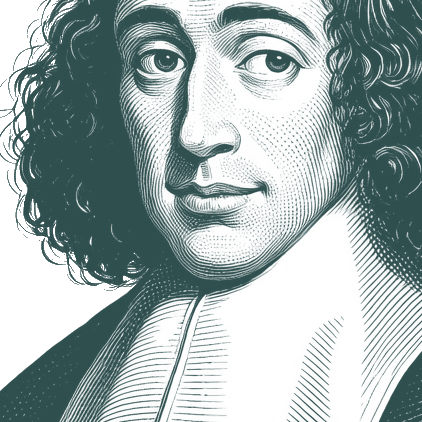
Recuérdese que la crítica se dirige hacia los usos públicos del poder político-religioso, no hacia las creencias privadas, y en ese ámbito es obligad… - Benedictus de Spinoza
""
Recuérdese que la crítica se dirige hacia los usos públicos del poder político-religioso, no hacia las creencias privadas, y en ese ámbito es obligada la beligerancia anticlerical
Benedictus de Spinoza (24 November 1632 – 21 February 1677) was a social and metaphysical philosopher known for the elaborate development of his monist philosophy, which has become known as Spinozism. Controversy regarding his ideas led to his excommunication from the Jewish community of his native Amsterdam. He was named Baruch ("blessed" in Hebrew) Spinoza by his synagogue elders and known as Bento de Spinoza or Bento d'Espiñoza, but afterwards used the name Benedictus ("blessed" in Latin) de Spinoza.
Native Name:
בָּרוּךְ שְׂפִּינוֹזָה
•
Benedito de Espinosa
Alternative Names:
Benedict de Spinoza
•
Baruch de Espinosa
•
Barukh Shpinozah
•
Benoît de Spinoza
•
Sbīnūzā
•
Ispīnūzā
•
Barukh Spinoza
•
Bento de Espinosa
•
Baruch d' Espinoza
•
Shpinozah
•
Baruch de Spinoza
•
Spinoza
•
Benoit de Spinoza
•
Benedictus De Spinoza
•
Benedictus Spinoza
•
Baruch Spinoza
•
Baruch Benedictus de Spinoza
Spinoza's philosophy introduced an unprecedented theoretical revolution in the history of philosophy, probably the greatest philosophical revolution of all time, insofar as we can regard Spinoza as Marx's only direct ancestor, from the philosophical standpoint. However, this radical revolution was the object of a massive historical repression, and Spinozist philosophy suffered much the same fate as Marxist philosophy used to and still does suffer in some countries: it served as damning evidence for a charge of ‘atheism’. The insistence of the seventeenth and eighteenth century establishment's hounding of Spinoza's memory, and the distance every writer had ineluctably to take with respect to Spinoza in order to obtain the right to speak (cf. Montesquieu) are evidence both of the repulsion and the extraordinary attraction of his thought. The history of philosophy's repressed Spinozism thus unfolded as a subterranean history acting at other sites (autres lieux), in political and religious ideology (deism) and in the sciences, but not on the illuminated stage of visible philosophy. And when Spinoza re-appeared on this stage in German idealism's ‘Atheismusstreit’, and then in academic interpretations, it was more or less under the aegis of a misunderstanding.
One of the ideas that I play around with in the book [Betraying Spinoza: The Renegade Jew Who Gave Us Modernity] is tracing a possible path from Spinoza's influence in Amsterdam to the founding fathers of America, by way of John Locke, who spent time in Amsterdam a few years after Spinoza's death and fraternized with people of the same liberal persuasion as those in whom Spinoza had confided his ideas. No matter whether Madison and Jefferson really did read Spinoza (Spinoza was in Jefferson's library) they often sound just like him in their letters.
PREMIUM FEATURE
Advanced Search Filters
Filter search results by source, date, and more with our premium search tools.
Speaking of Spinoza he [Nietzsche] says: "How much of personal timidity and vulnerability does this masquerade of a sickly recluse betray!" Exactly the same may be said of him, with the less reluctance since he has not hesitated to say it of Spinoza. It is obvious that in his day-dreams he is a warrior, not a professor; all the men he admires were military.