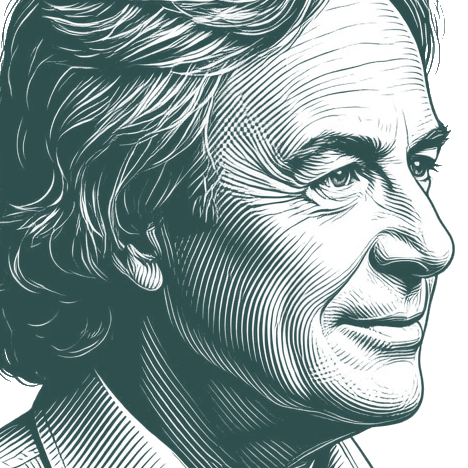
Suppose two politicians are running for president, and one goes through the farm section and is asked, "What are you going to do about the farm quest… - Richard Feynman
""
Suppose two politicians are running for president, and one goes through the farm section and is asked, "What are you going to do about the farm question?" And he knows right away - bang, bang, bang. Now he goes to the next campaigner who comes through. "What are you going to do on the farm problem?" "Well, I don't know. I used to be a general, and I don't know anything about farming. But it seems to me it must be a very difficult problem, because for twelve, fifteen, twenty years people have been struggling with it, and people say that they know how to solve the farm problem. And it must be a hard problem. So the way I intend to solve the farm problem is to gather around me a lot of people who know something about it, to look at all the experience that we have had with this problem before, to take a certain amount of time at it, and then to come to some conclusion in a reasonable way about it. Now, I can't tell you ahead of time what solution, but I can give you some of the principles I'll try to use - not to make things difficult for individual farmers, if there are any special problems we will have to have some way to take care of them," etc., etc., etc. Now such a man would never get anywhere in this country, I think. It's never been tried, anyway. This is in the attitude of mind of the populace, that they have to have an answer and that a man who gives an answer is better than a man who gives no answer, when the real fact of the matter is, in most cases, it is the other way around. And the result of this of course is that the politician must give an answer. And the result of this is that political promises can never be kept. It is a mechanical fact; it is impossible. The result of that is that nobody believes campaign promises. And the result of that is a general disparaging of politics, a general lack of respect for the people who are trying to solve problems, and so forth. It's all generated from the very beginning (maybe - this is a simple analysis). It's all generated, maybe, by the fact that the attitude of the populace is to try to find the answer instead of trying to find a man who has a way of getting at the answer.
English
Collect this quote
About
Richard Feynman
Richard Phillips Feynman (May 11, 1918 – February 15, 1988) was an American theoretical physicist. He is known for the work he did in the path integral formulation of quantum mechanics, the theory of quantum electrodynamics, the physics of the superfluidity of supercooled liquid helium, and in particle physics, for which he proposed the parton model. For his contributions to the development of quantum electrodynamics, Feynman received the Nobel Prize in Physics in 1965 jointly with Julian Schwinger and Shin'ichirō Tomonaga. Feynman developed a widely used pictorial representation scheme for the mathematical expressions describing the behavior of subatomic particles, which later became known as Feynman diagrams. During his lifetime, Feynman became one of the best-known scientists in the world.
Biography information from
Wikiquote·
Portrait adapted from
Wikimedia Commons, Copyright Tamiko Thiel 1984 (CC BY-SA)
Also Known As
Pen Names:
Ofey
Native Name:
Richard Phillips Feynman
Alternative Names:
Feynman
•
Dick Feynman
•
Richard P. Feynman
Well, Mr. Frankel, who started this program, began to suffer from the computer disease that anybody who works with computers now knows about. It's a very serious disease and it interferes completely with the work. The trouble with computers is you *play* with them. They are so wonderful. You have these switches - if it's an even number you do this, if it's an odd number you do that - and pretty soon you can do more and more elaborate things if you are clever enough, on one machine.
After a while the whole system broke down. Frankel wasn't paying any attention; he wasn't supervising anybody. The system was going very, very slowly - while he was sitting in a room figuring out how to make one tabulator automatically print arc-tangent X, and then it would start and it would print columns and then bitsi, bitsi, bitsi, and calculate the arc-tangent automatically by integrating as it went along and make a whole table in one operation.
Absolutely useless. We *had* tables of arc-tangents. But if you've ever worked with computers, you understand the disease - the *delight* in being able to see how much you can do. But he got the disease for the first time, the poor fellow who invented the thing.
So our problem is to explain where symmetry comes from. Why is nature so nearly symmetrical? No one has any idea why. The only thing we might suggest is something like this: There is a gate in Japan, a gate in Neiko, which is sometimes called by the Japanese the most beautiful gate in all Japan; it was built in a time when there was great influence from Chinese art. This gate is very elaborate, with lots of gables and beautiful carving and lots of columns and dragon heads and princes carved into the pillars, and so on. But when one looks closely he sees that in the elaborate and complex design along one of the pillars, one of the small design elements is carved upside down; otherwise the thing is completely symmetrical. If one asks why this is, the story is that it was carved upside down so that the gods will not be jealous of the perfection of man. So they purposely put an error in there, so that the gods would not be jealous and get angry with human beings. We might like to turn the idea around and think that the true explanation of the near symmetry of nature is this: that God made the laws only nearly symmetrical so that we should not be jealous of His perfection!
I don’t believe in honors, it bothers me, honors bother, honors is epaulettes, honors is uniforms. My papa brought me up this way. I can’t stand it, it hurts me.