There was no solution, but that universal solution which life gives to all questions, even the most complex and insoluble. That answer is: one must l… - Leo Tolstoy
""
There was no solution, but that universal solution which life gives to all questions, even the most complex and insoluble. That answer is: one must live in the needs of the day — that is, forget oneself. To forget himself in sleep was impossible now, at least till nighttime; he could not go back now to the music sung by the decanter-women; so he must forget himself in the dream of daily life.
Lev Nikolayevitch Tolstoy [Ле́в Никола́евич Толсто́й, usually rendered Leo Tolstoy, or sometimes Tolstoi] (9 September 1828 – 20 November 1910) was a Russian writer, philosopher and social activist (social critic), whose novels War and Peace and Anna Karenina are internationally praised classics of world literature. He was a major influence on the development of Christian anarchism and pacifism, contributing to such nonviolent resistance movements as those of Mahatma Gandhi, Martin Luther King, Jr., and James Bevel.
Biography information from
Wikiquote·
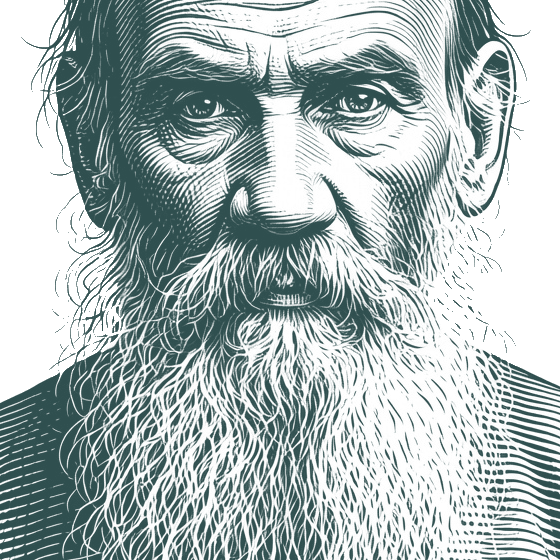
Portrait adapted from
Wikimedia Commons, Sergei Prokudin-Gorskii (Public domain / CC0)
Also Known As
Pen Names:
Л. Н. Т.
•
Л. Н.
Birth Name:
Lev Nikolayevich Tolstoy
Native Name:
Лев Никола́евич Толсто́й
Alternative Names:
Count Lev Nikolayevich Tolstoy
•
Tolstoy, Leo, graf, 1828-1910
•
Tolstoĭ, Lev Nikolaevich, graf, 1828-1910
•
Lev Nikolayevich Tolstoĭ
•
Leo Tolstoi
•
Tolstoĭ, Lev Nikolaevich, graf
•
Tolstoy, Leo, graf
Portrait from Wikimedia Commons. Credit: Sergei Prokudin-Gorskii. Used under Public domain / CC0. Processed and styled by Quotewise.
Try QuoteGPT
Chat naturally about what you need. Each answer links back to real quotes with citations.
Related quotes. More quotes will automatically load as you scroll down, or you can use the load more buttons.
Shorter versions of this quote
There was no answer, except the general answer life gives to all the most complex and insoluble questions. That answer is: one must live for the needs of the day, in other words, become oblivious.
There was no solution, save that universal solution which life gives to all questions, even the most complex and insolvable: One must live in the needs of the day — that is, forget oneself.
She had no need to ask why he had come. She knew as certainly as if he had told her that he was here to be where she was.
Levin had been married three months. He was happy, but not at all in the way he had expected to be. At every step he found his former dreams disappointed, and new, unexpected surprises of happiness. He was happy; but on entering upon family life he saw at every step that it was utterly different from what he had imagined. At every step he experienced what a man would experience who, after admiring the smooth, happy course of a little boat on a lake, should get himself into that little boat. He saw that it was not all sitting still, floating smoothly; that one had to think too, not for an instant to forget where one was floating; and that there was water under one, and that one must row; and that his unaccustomed hands would be sore; and that it was only to look at it that was easy; but that doing it, though very delightful, was very difficult.
But that's the whole aim of civilization: to make everything a source of enjoyment.