...sometimes different cities follow one another on the same site and under the same name, born and dying without knowing one another, without commun… - Italo Calvino
""
...sometimes different cities follow one another on the same site and under the same name, born and dying without knowing one another, without communication among themselves. At times even the names of the inhabitants remain the same, and their voices’ accent, and also the features of the faces; but the gods who live beneath names and above places have gone off without a word and outsiders have settled in their place. It is pointless to ask whether the new ones are better or worse than the old, since there is no connection between them, just as the old postcards do not depict Maurilia as it was, but a different city which, by chance, was called Maurilia, like this one.
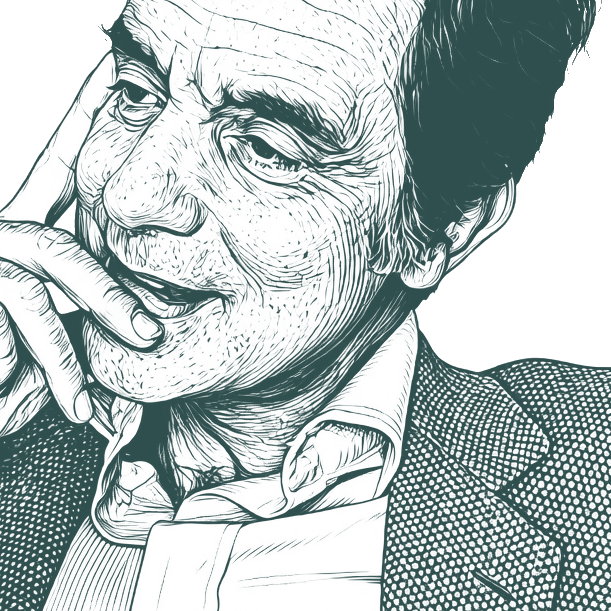
Italo Calvino (October 15, 1923 – September 19, 1985) was an Italian journalist and writer of short stories and novels. Lionized in Britain and America, he was, at the time of his death, the most-translated contemporary Italian writer.
Biography information from
Wikiquote·
Portrait adapted from
Wikimedia Commons, The original uploader was Varie11 at Italian Wikipedia. (Public domain / CC0)
Also Known As
Alternative Names:
Italo Giovanni Calvino
•
Italo Giovanni Calvino Mameli
It is pointless trying to decide whether Zenobia is to be classified among happy cities or among the unhappy. It makes no sense to divide cities into these two species, but rather into another two: those that through the years and the changes continue to give their form to desires, and those in which desires either erase the city or are erased by it.
Imagine I can see her, her or something of her, but only her, in a hundred, a thousand different vistas, she who makes the Moon and, whenever she is full, sets the dogs to howling all night long, and me with them.
What makes Argia different from other cities is that it has earth instead of air. The streets are completely filled with dirt, clay packs the rooms to the ceiling, on every stair another stairway is set in negative, over the roofs of the houses hang layers of rocky terrain like skies with clouds. We do not know if the inhabitants can move about the city, widening the worm tunnels and the crevices where roots twist: the dampness destroys people’s bodies and they have scant strength; everyone is better off remaining still, prone; anyway, it is dark. From up here, nothing of Argia can be seen; some say, “It’s down below there,” and we can only believe them. The place is deserted. At night, putting your ear to the ground, you can sometimes hear a door slam.