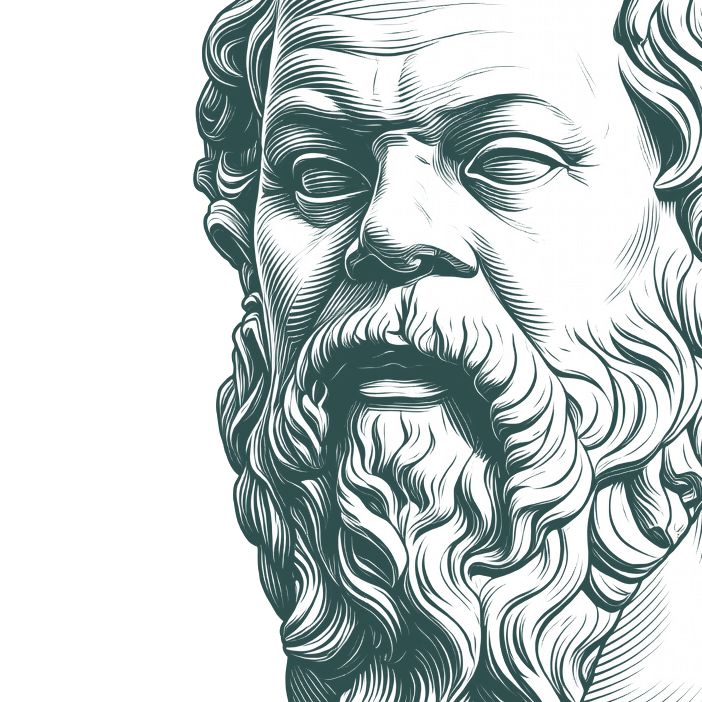
If all our misfortunes were laid in one common heap whence everyone must take an equal portion, most people would be content to take their own and de… - Socrates
""
If all our misfortunes were laid in one common heap whence everyone must take an equal portion, most people would be content to take their own and depart.
Socrates (Σωκράτης; c. 470 BC – 399 BC) was a classical Greek (Athenian) philosopher credited as one of the founders of Western philosophy. Through his portrayal in Plato's dialogues, Socrates has become renowned for his contribution to the field of ethics, and it is this Platonic Socrates who lends his name to the concepts of Socratic irony and the Socratic method, or elenchus. The latter remains a commonly used tool in a wide range of discussions, and is a type of pedagogy in which a series of questions is asked not only to draw individual answers, but also to encourage fundamental insight into the issue at hand.
Biography information from
Wikiquote·
Portrait adapted from
Wikimedia Commons, Copy of Lysippos (?) (Public domain / CC0)
Pero no es difícil, varones, huir de la muerte; muy más difícil es huir de la maldad, que corre más veloz que la muerte. Yo ahora, por tardo y por viejo, seguramente, he sido cogido por lo más lento, mientras que mis acusadores, por hábiles y por vivos, han sido cogidos por lo más veloz: por la maldad
Think not those faithful who praise all thy words and actions; but those who kindly reprove thy faults.
PREMIUM FEATURE
Advanced Search Filters
Filter search results by source, date, and more with our premium search tools.