at least where there is enough, and as good, left in common for others. - John Locke
""
at least where there is enough, and as good, left in common for others.
English
Collect this quote
About
John Locke
John Locke (29 August 1632 – 28 October 1704) was an influential English philosopher and social contract theorist. He developed an alternative to the Hobbesian state of nature and asserted a government could be good only if it received the consent of the governed and protected the natural rights of life, liberty, and estate. If such a consent was not achieved, Locke argued in favour of a right of rebellion, which he referred to as an "appeal to heaven".
Biography information from
Wikiquote·
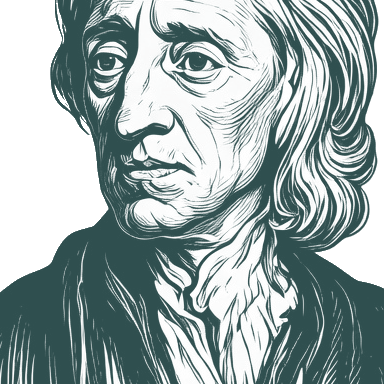
Portrait adapted from
Wikimedia Commons, Godfrey Kneller (Public domain / CC0)
I therefore took it into my hands with all the expectation and read it through with all the attention due to a Treaties, that made such a noise at its coming abroad and cannot but confess my self mightily surprised, that in a Book which was to provide Chains for all Mankind, I should find nothing but a Rope of Sand, useful perhaps to such, whose Skill and Business it is to raise a Dust, and would blind the People, the better to mislead them, but in truth is not of any force to draw those into Bondage, who have their Eyes open, and so much Sense about them as to consider, that Chains are but an Ill wearing, how much Care soever hath been taken to file and polish them.
It is evident the mind knows not things immediately, but only by the intervention of the ideas it has of them.
Go Premium
Support Quotewise while enjoying an ad-free experience and premium features.
As men, we have God for our King, and are under the law of reason: as Christians, we have Jesus the Messiah for our King, and are under the law revealed by him in the gospel. And though every Christian, both as a deist and a Christian, be obliged to study both the law of nature and the revealed law, that in them he may know the will of God, and of Jesus Christ, whom he hath sent; yet, in neither of these laws, is there to be found a select set of fundamentals, distinct from the rest, which are to make him a deist, or a Christian. But he that believes one eternal, invisible God, his Lord and King, ceases thereby to be an atheist; and he that believes Jesus to be the Messiah, his king, ordained by God, thereby becomes a Christian, is delivered from the power of darkness, and is translated into the kingdom of the Son of God; is actually within the covenant of grace, and has that faith, which shall be imputed to him for righteousness; and, if he continues in his allegiance to this his King, shall receive the reward: eternal life.