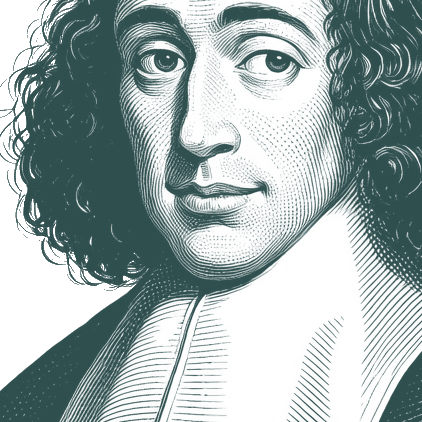
My ancestors Heraclitus, Empedocles, Spinoza, Goethe. [Original in German: meine Vorfahren Heraclit Empedocles Spinoza Goethe.] - Benedictus de Spinoza
""
My ancestors Heraclitus, Empedocles, Spinoza, Goethe. [Original in German: meine Vorfahren Heraclit Empedocles Spinoza Goethe.]
English
Collect this quote
About
Benedictus de Spinoza
Benedictus de Spinoza (24 November 1632 – 21 February 1677) was a social and metaphysical philosopher known for the elaborate development of his monist philosophy, which has become known as Spinozism. Controversy regarding his ideas led to his excommunication from the Jewish community of his native Amsterdam. He was named Baruch ("blessed" in Hebrew) Spinoza by his synagogue elders and known as Bento de Spinoza or Bento d'Espiñoza, but afterwards used the name Benedictus ("blessed" in Latin) de Spinoza.
Native Name:
בָּרוּךְ שְׂפִּינוֹזָה
•
Benedito de Espinosa
Alternative Names:
Benedict de Spinoza
•
Baruch de Espinosa
•
Barukh Shpinozah
•
Benoît de Spinoza
•
Sbīnūzā
•
Ispīnūzā
•
Barukh Spinoza
•
Bento de Espinosa
•
Baruch d' Espinoza
•
Shpinozah
•
Baruch de Spinoza
•
Spinoza
•
Benoit de Spinoza
•
Benedictus De Spinoza
•
Benedictus Spinoza
•
Baruch Spinoza
•
Baruch Benedictus de Spinoza
[...] In this Spartan room there was a man pacing little steps, his hands clasped behind his back, his big head thrust forward as though to butt. The man looked exactly like Ben-Gurion, but there was no way he could actually be Ben-Gurion. Every child in Israel, even in kindergarten, in those days knew in his sleep what Ben-Gurion looked like. But since there was no television yet, it was obvious to me that the Father of the Nation was a giant whose head reached the clouds, whereas this impostor was a short, tubby man whose height was less than five foot three. (...) David Ben-Gurion was about seventy-five at the time, and I was barely twenty. (...) I sat down in a flash on the chair facing the desk. I sat bolt upright, but only on the edge of the chair. There was no question of leaning back. Silence. The Father of the Nation continued to pace to and fro with hasty little steps, like a caged lion or someone who was determined not to be late. After half an eternity, he suddenly said: “Spinoza!” And he stopped. When he had walked away as far as the window, he whirled around and said: “Have you read Spinoza? You have. But maybe you didn't understand? Few people understand Spinoza. Very few.” And then, still pacing to and fro, to and fro, between the window and the door, he burst into a protracted dawn lecture on Spinoza's thought. (...) But Ben-Gurion, it turned out, was enjoying lecturing on Spinoza before seven o'clock in the morning. And he did indeed continue for a few minutes without interruption.
Humanam impotentiam in moderandis et coercendis affectibus servitutem voco; homo enim affectibus obnoxius sui juris non est sed fortunæ in cujus potestate ita est ut sæpe coactus sit quanquam meliora sibi videat, deteriora tamen sequi.
Works in ChatGPT, Claude, or Any AI
Add semantic quote search to your AI assistant via MCP. One command setup.
Spinoza has long intrigued me, and for years I've wanted to write about this valiant seventeenth-century thinker, so alone in the world—without a family, without a community—who authored books that truly changed the world. He anticipated secularization, the liberal democratic political state, and the rise of natural science, and he paved the way for the Enlightenment. The fact that he was excommunicated by the Jews at the age of twenty-four and censored for the rest of his life by the Christians had always fascinated me, perhaps because of my own iconoclastic proclivities. And this strange sense of kinship with Spinoza was strengthened by the knowledge that Einstein, one of my first heroes, was a Spinozist. When Einstein spoke of God, he spoke of Spinoza's God—a God entirely equivalent to nature, a God that includes all substance, and a God “that doesn't play dice with the universe”—by which he means that everything that happens, without exception, follows the orderly laws of nature.