For, when you are approaching poverty, you make one discovery which outweighs some of the others. You discover boredom and mean complications and the… - George Orwell
""
For, when you are approaching poverty, you make one discovery which outweighs some of the others. You discover boredom and mean complications and the beginnings of hunger, but you also discover the great redeeming feature of poverty: the fact that it annihilates the future. Within certain limits, it is actually true that the less money you have, the less you worry. When you have a hundred francs in the world you are liable to the most craven panics. When you have only three francs you are quite indifferent; for three francs will feed you till tomorrow, and you cannot think further than that. You are bored, but you are not afraid. You think vaguely, 'I shall be starving in a day or two--shocking, isn't it?' And then the mind wanders to other topics. A bread and margarine diet does, to some extent, provide its own anodyne. And there is another feeling that is a great consolation in poverty. I believe everyone who has been hard up has experienced it. It is a feeling of relief, almost of pleasure, at knowing yourself at last genuinely down and out. You have talked so often of going to the dogs--and well, here are the dogs, and you have reached them, and you can stand it. It takes off a lot of anxiety.
George Orwell (25 June 1903 – 21 January 1950) was the pen name of British novelist, essayist, and journalist Eric Arthur Blair, whose work is characterised by lucid prose, awareness of social injustice, opposition to totalitarianism, and strong support of democratic socialism.
Biography information from
Wikiquote·
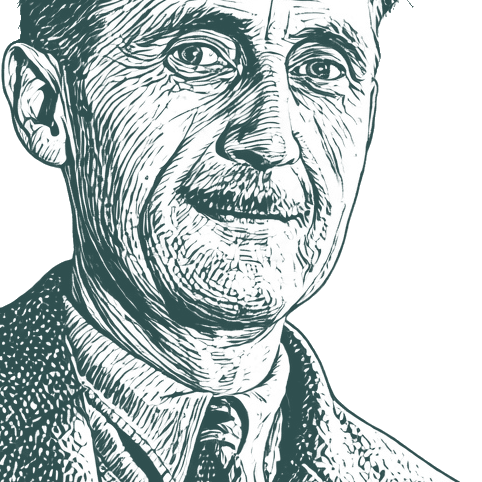
Portrait adapted from
Wikimedia Commons, Cassowary Colorizations (CC BY)
Also Known As
Pen Names:
John Freeman
Birth Name:
Eric Arthur Blair
Alternative Names:
Orwell
•
Eric Blair
•
P. S. Burton
Related quotes. More quotes will automatically load as you scroll down, or you can use the load more buttons.
Shorter versions of this quote
Within certain limits, it is actually true that the less money you have, the less you worry.
For, when you are approaching poverty, you make one discovery which outweighs some of the others. You discover boredom and mean complications and the beginnings of hunger, but you also discover the great redeeming feature of poverty: the fact that it annihilates the future. Within certain limits, it is actually true that the less money you have, the less you worry.
The essence of being human is that one does not seek perfection.
The Lottery, with its weekly pay-out of enormous prizes, was the one public event to which the proles paid serious attention. It was probable that there were some millions of proles for whom the Lottery was the principal if not the only reason for remaining alive. It was their delight, their folly, their anodyne, their intellectual stimulant. Where the Lottery was concerned, even people who could barely read and write seemed capable of intricate calculations and staggering feats of memory. There was a whole tribe of men who made their living simply by selling systems, forecasts, and lucky amulets. Winston had nothing to do with the Lottery, which was managed by the Ministry of Plenty, but he was aware (indeed everyone in the party was aware) that the prizes were largely imaginary. Only small sums were actually paid out, the winners of the big prizes being nonexistent persons.
Go Premium
Support Quotewise while enjoying an ad-free experience and premium features.
The war is not meant to be won, it is meant to be continuous. Hierarchical society is only possible on the basis of poverty and ignorance. This new version is the past and no different past can ever have existed. In principle the war effort is always planned to keep society on the brink of starvation. The war is waged by the ruling group against its own subjects and its object is not the victory over either Eurasia or East Asia, but to keep the very structure of society intact.