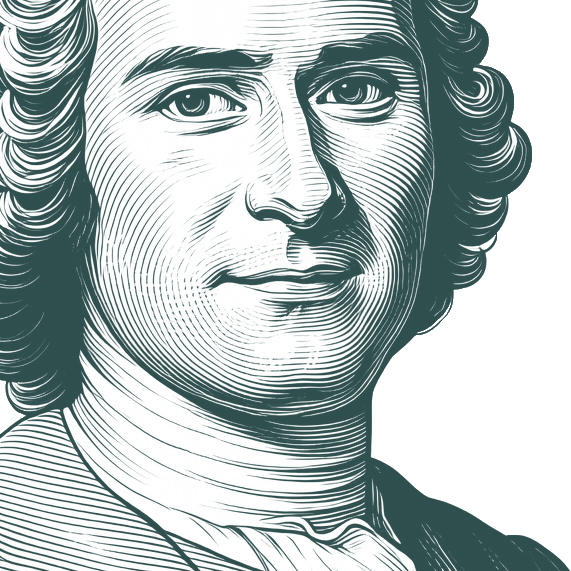
Leben heißt nicht atmen, sondern handeln; es heißt, sich unserer Organe, unserer Sinne, unserer Fähigkeiten, sich also aller derjenigen Teile von uns… - Jean-Jacques Rousseau

" "

Leben heißt nicht atmen, sondern handeln; es heißt, sich unserer Organe, unserer Sinne, unserer Fähigkeiten, sich also aller derjenigen Teile von uns zu bedienen, die uns die Empfindung unseres Daseins verleihen. Nicht derjenige Mensch hat am meisten gelebt, der die meisten Lebensjahre gezählt hat, sondern der, welcher sein Leben am meisten empfunden hat.

German
Collect this quote

About Jean-Jacques Rousseau

Jean-Jacques Rousseau (June 28, 1712 – July 2, 1778) was a major French-speaking Genevan philosopher of Enlightenment whose political ideas influenced the French Revolution, the development of socialist theory, and the growth of nationalism.

Biography information from Wikiquote

Also Known As

Alternative Names: Citizen of Geneva Jean Jacques Rousseau J. J. Rousseau Rousseau J.J. Rousseau JJ Rousseau
Enhance Your Quote Experience

Enjoy ad-free browsing, unlimited collections, and advanced search features with Premium.

Related quotes. More quotes will automatically load as you scroll down, or you can use the load more buttons.

Additional quotes by Jean-Jacques Rousseau

Happiness has no particular outward sign to discover itself by; we must be able to view the heart before we can be certain who are truly happy; but contentment is to be read in the eyes, the conversation, the accent, the manner, and seems to communicate itself to him that perceives it.

Romans had been content to practice virtue; all was lost when they began to study it.

Works in ChatGPT, Claude, or Any AI

Add semantic quote search to your AI assistant via MCP. One command setup.

At first our pupil had merely sensations, now he has ideas; he could only feel, now he reasons. For from the comparison of many successive or simultaneous sensations and the judgment arrived at with regard to them, there springs a sort of mixed or complex sensation which I call an idea. The way in which ideas are formed gives a character to the human mind. The mind which derives its ideas from real relations is thorough; the mind which relies on apparent relations is superficial. He who sees relations as they are has an exact mind; he who fails to estimate them aright has an inaccurate mind; he who concocts imaginary relations, which have no real existence, is a madman; he who does not perceive any relation at all is an imbecile. Clever men are distinguished from others by their greater or less aptitude for the comparison of ideas and the discovery of relations between them. Simple ideas consist merely of sensations compared one with another. Simple sensations involve judgments, as do the complex sensations which I call simple ideas. In the sensation the judgment is purely passive; it affirms that I feel what I feel. In the percept or idea the judgment is active; it connects, compares, it discriminates between relations not perceived by the senses. That is the whole difference; but it is a great difference. Nature never deceives us; we deceive ourselves.

Loading...