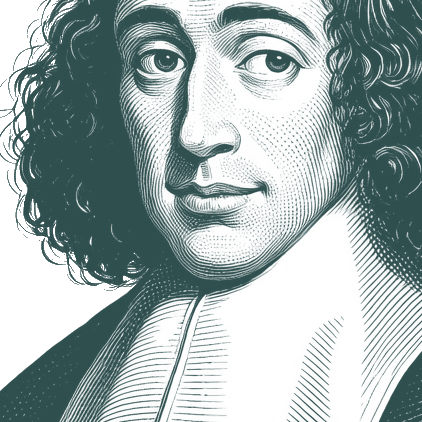
Bruma de oro, el occidente alumbra La ventana. El asiduo manuscrito Aguarda, ya cargado de infinito. Alguien construye a Dios en la penumbra. Un homb… - Benedictus de Spinoza
""
Bruma de oro, el occidente alumbra La ventana. El asiduo manuscrito Aguarda, ya cargado de infinito. Alguien construye a Dios en la penumbra. Un hombre engendra a Dios. Es un judío De tristes ojos y piel cetrina; Lo lleva el tiempo como lleva el río Una hoja en el agua que declina. No importa. El hechicero insiste y labra A Dios con geometría delicada; Desde su enfermedad, desde su nada, Sigue erigiendo a Dios con la palabra. El más pródigo amor le fue otorgado, El amor que no espera ser amado. (A haze of gold, the Occident lights up The window. Now, the assiduous manuscript Is waiting, weighed down with the infinite. Someone is building God in a dark cup. A man engenders God. He is a Jew With saddened eyes and lemon-colored skin; Time carries him the way a leaf, dropped in A river, is borne off by waters to Its end. No matter. The magician moved Carves out his God with fine geometry; From his disease, from nothing, he's begun To construct God, using the word. No one Is granted such prodigious love as he: The love that has no hope of being loved.) [Translated from the Spanish by Willis Barnstone]
Benedictus de Spinoza (24 November 1632 – 21 February 1677) was a social and metaphysical philosopher known for the elaborate development of his monist philosophy, which has become known as Spinozism. Controversy regarding his ideas led to his excommunication from the Jewish community of his native Amsterdam. He was named Baruch ("blessed" in Hebrew) Spinoza by his synagogue elders and known as Bento de Spinoza or Bento d'Espiñoza, but afterwards used the name Benedictus ("blessed" in Latin) de Spinoza.
Native Name:
בָּרוּךְ שְׂפִּינוֹזָה
•
Benedito de Espinosa
Alternative Names:
Benedict de Spinoza
•
Baruch de Espinosa
•
Barukh Shpinozah
•
Benoît de Spinoza
•
Sbīnūzā
•
Ispīnūzā
•
Barukh Spinoza
•
Bento de Espinosa
•
Baruch d' Espinoza
•
Shpinozah
•
Baruch de Spinoza
•
Spinoza
•
Benoit de Spinoza
•
Benedictus De Spinoza
•
Benedictus Spinoza
•
Baruch Spinoza
•
Baruch Benedictus de Spinoza
One of Spinoza's more famous, influential and incendiary doctrines concerns the origin and status of Scripture. The Bible, Spinoza argues in the Theological-Political Treatise, was not literally authored by God. God or Nature is metaphysically incapable of proclaiming or dictating, much less writing, anything. Scripture is not ‘a message for mankind sent down by God from heaven’. Rather, it is a very mundane document. Texts from a number of authors of various socio-economic backgrounds, writing at different points over a long stretch of time and in differing historical and political circumstances, were passed down through generations in copies after copies after copies. [...] Spinoza supplements his theory of the human origins of Scripture with an equally deflationary account of its authors. The prophets were not especially learned individuals. They did not enjoy a high level of education or intellectual sophistication. They certainly were not philosophers or physicists or astronomers. There are no truths about nature or the cosmos to be found in their writings (Joshua believed that the Sun revolved around the Earth). Neither are they a source of metaphysical or even theological truths. The prophets often had naïve, even philosophically false beliefs about God.
I have thus completed all I wished to set forth touching the mind's power over the emotions and the mind's freedom. Whence it appears how potent is the wise man and how much he surpasses the ignorant man who is driven only by his lusts. For the ignorant man is not only distracted in various ways by external causes without ever gaining the true acquiescence of his spirit, but more over lives, as it were, unwitting of himself, and of God, and of things, and as soon as he ceases to suffer, ceases also to be: Whereas the wise man, in as far as he is regarded as such, is scarcely at all disturbed in spirit, but, being conscious of himself, and of God, and of things, by a certain eternal necessity, never ceases to be, but always possesses true acquiescence of his spirit. If the way which I have pointed out as leading to this result, seems exceedingly hard, it may nevertheless be discovered. Needs must it be hard, since it is so seldom found. How would it be possible, if salvation were ready to our hand, and could without great labour be found, that it should be by almost all men neglected? But all things excellent are as di_fcult as they are rare.
Works in ChatGPT, Claude, or Any AI
Add semantic quote search to your AI assistant via MCP. One command setup.
To express myself briefly, Goethe was the Spinoza of poetry. The whole of Goethe's poetry is filled with the same spirit that is wafted toward us from the writings of Spinoza. There is no doubt whatsoever that Goethe paid undivided allegiance to Spinoza's doctrine. At any rate, he occupied himself with it throughout his entire life; in the first part of his memoirs as well as in the last volume, recently published, he frankly acknowledged this. I don't remember now where I read that Herder once exploded peevishly at the constant preoccupation with Spinoza, "If Goethe would only for once pick up some other Latin book than Spinoza!" But this applies not only to Goethe; quite a number of his friends, who later became more or less well-known as poets, paid homage to pantheism in their youth, and this doctrine flourished actively in German art before it attained supremacy among us as a philosophic theory.