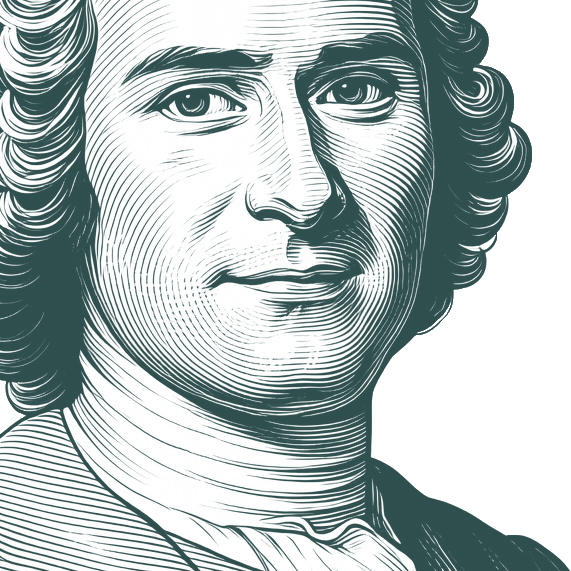
L'indépendance que je croyais avoir acquise était le seul sentiment qui m'affectait. Libre et maître de moi-même, je croyais pouvoir tout faire, atte… - Jean-Jacques Rousseau
""
L'indépendance que je croyais avoir acquise était le seul sentiment qui m'affectait. Libre et maître de moi-même, je croyais pouvoir tout faire, atteindre à tout : je n'avais qu'à m'élancer pour m'élever et voler dans les airs.
Jean-Jacques Rousseau (June 28, 1712 – July 2, 1778) was a major French-speaking Genevan philosopher of Enlightenment whose political ideas influenced the French Revolution, the development of socialist theory, and the growth of nationalism.
Biography information from
Wikiquote·
Portrait adapted from
Wikimedia Commons, Maurice Quentin de La Tour (Public domain / CC0)
Also Known As
Alternative Names:
Citizen of Geneva
•
Jean Jacques Rousseau
•
J. J. Rousseau
•
Rousseau
•
J.J. Rousseau
•
JJ Rousseau
Qu'un homme vienne nous tenir ce langage : Mortels, je vous annonce la volonté du Très-Haut ; reconnaissez à ma voix celui qui m'envoie ; j'ordonne au soleil de changer sa course, aux étoiles de former un autre arrangement, aux montagnes de s'aplanir, aux flots de s'élever, à la terre de prendre un autre aspect. À ces merveilles, qui ne reconnaîtra pas à l'instant le maître de la nature ! Elle n'obéit point aux imposteurs ; leurs miracles se font dans des carrefours, dans des déserts, dans des chambres ; et c'est là qu'ils ont bon marché d'un petit nombre de spectateurs déjà disposés à tout croire. Qui est-ce qui m'osera dire combien il faut de témoins oculaires pour rendre un prodige digne de foi ? Si vos miracles, faits pour prouver votre doctrine, ont eux-mêmes besoin d'être prouvés, de quoi servent-ils ? autant valait n'en point faire.
At first our pupil had merely sensations, now he has ideas; he could only feel, now he reasons. For from the comparison of many successive or simultaneous sensations and the judgment arrived at with regard to them, there springs a sort of mixed or complex sensation which I call an idea. The way in which ideas are formed gives a character to the human mind. The mind which derives its ideas from real relations is thorough; the mind which relies on apparent relations is superficial. He who sees relations as they are has an exact mind; he who fails to estimate them aright has an inaccurate mind; he who concocts imaginary relations, which have no real existence, is a madman; he who does not perceive any relation at all is an imbecile. Clever men are distinguished from others by their greater or less aptitude for the comparison of ideas and the discovery of relations between them. Simple ideas consist merely of sensations compared one with another. Simple sensations involve judgments, as do the complex sensations which I call simple ideas. In the sensation the judgment is purely passive; it affirms that I feel what I feel. In the percept or idea the judgment is active; it connects, compares, it discriminates between relations not perceived by the senses. That is the whole difference; but it is a great difference. Nature never deceives us; we deceive ourselves.
Try QuoteGPT
Chat naturally about what you need. Each answer links back to real quotes with citations.
Çocuklara saygı gösterin ve onlar hakkında iyi ya da kötü diye yargıda bulunmakta acele etmeyin. İstisnalar için özel yöntemler benimsemeden önce, bunların belirlenmesi, kanıtlanması, doğrulanması için zaman bırakın. Bırakın, doğa uzun süre bildiği gibi davransın, sonra, yaptıklarını bozmaktan korka korka, onun yerine davranmak için harekete geçin. Zamanın değerini bildiğinizi söylüyor ve hiç zaman kaybetmek istemiyorsunuz, öyle mi? Görmüyorsunuz ki, zamanı kötüye kullanmak hiçbir şey yapmamaktan daha çok zaman kaybetmektir ve kötü yetişmiş bir çocuk, hiç yetiştirilmemiş olan bir çocuğa göre bilgelikten daha uzaktır. Onun ilk yıllarını hiçbir şey yapmayarak boşa tükettiğini görmekten kaygıya düşüyorsunuz, öyle mi? Nasıl olur! Mutlu olmak hiçbir şey yapmamak mıdır? Gün boyunca zıplamak, oynamak, koşmak hiçbir şey yapmamak mıdır? Ömrü boyunca hiç bu kadar meşgul olmayacaktır. Platon, çok katı olduğu sanılan devletinde çocukları yalnızca şenliklerle, oyunlarla, şarkılarla, eğlencelerle yetiştirir; onlara iyi eğlenmeyi öğrettiğinde her şeyi yapmış gibidir; Seneca da eski Roma gençliğinden söz ederken, bu gençlik her zaman ayaktaydı, ona oturarak öğrenmesi gereken hiçbir şey öğretilmezdi, diyor. Erginlik çağına geldiğinde daha az mı değerli oluyordu bu gençlik? Siz bu sözde aylaklıktan pek korkmayın. Tüm yaşamından yararlanmak için hiç uyumak istemeyen bir adam hakkında ne düşünürsünüz? Belki şöyle dersiniz: Bu adam kaçık; zamandan yararlanmıyor, zamanı kendinden uzaklaştırıyor: Uykudan kaçmak için ölüme koşuyor. Öyleyse düşünün ki burada da aynı şey söz konusudur ve çocukluk aklın uykusudur.