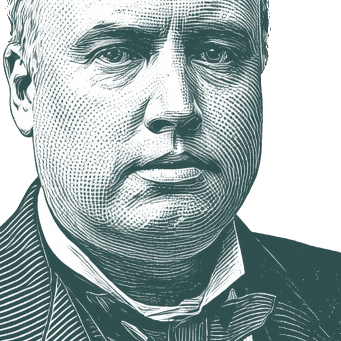
Waktu untuk berbahagia itu sekarang,
Tempat untuk berbahagia itu di sini,
Cara untuk berbahagia ialah dengan membuat orang lain berbahagia. - Robert Green Ingersoll
""
Waktu untuk berbahagia itu sekarang, Tempat untuk berbahagia itu di sini, Cara untuk berbahagia ialah dengan membuat orang lain berbahagia.
Robert Green Ingersoll (August 11, 1833 – July 21, 1899) was a lawyer, a Civil War veteran, political leader, and orator of the United States during the Golden Age of Freethought, noted for his broad range of culture and his defense of agnosticism. He was nicknamed "The Great Agnostic".
Biography information from
Wikiquote·
Portrait adapted from
Wikimedia Commons, Mathew Benjamin Brady / Levin Corbin Handy (Public domain / CC0)
Also Known As
Alternative Names:
Robert Ingersoll
•
The Great Agnostic
•
Robert G. Ingersoll
Portrait from Wikimedia Commons. Credit: Mathew Benjamin Brady / Levin Corbin Handy. Used under Public domain / CC0. Processed and styled by Quotewise.
Unlimited Quote Collections
Organize your favorite quotes without limits. Create themed collections for every occasion with Premium.
The church has not been in the habit of pursuing enemies with kind words and charitable deeds. To tell the truth, it has always been rather relentless. It has preached forgiveness, but it has never forgiven. There is in the history of Christendom no instance where the church has extended the hand of friendship to a man who denied the truth of its creed. There is in the church no spirit—no climate—of compromise. In the nature of things there can be none, because the church claims that it is absolutely right—that there is only one road leading to heaven. It demands unconditional surrender. It will not bear contradiction. It claims to have the absolute truth. For these reasons it cannot consistently compromise, any more than a mathematician could change the multiplication table to meet the view of some one who should deny that five times five are twenty-five.
I find that people who believe in immortality—or at least those who say they do—are just as afraid of death as anybody else. I find that the most devout Christian weeps as bitterly above his dead, as the man who says that death ends all. You see the promises are so far away, and the dead are so near. Still, I do not say that man is not immortal; but I do say that there is nothing in the Bible to show that he is. The Old Testament has not a word upon the subject—except to show us how we lost immortality.
PREMIUM FEATURE
Advanced Search Filters
Filter search results by source, date, and more with our premium search tools.
The Mosaic dispensation was better adapted to prevent the commission of sin than the Christian system. Under that dispensation, if you committed a sin, you had to bring a sacrifice—dove, sheep, or bullock, now, when a sin is committed, the Christian says, “Charge it,” “Put it on the slate, If I don’t pay it the Savior will.” In this way, rascality is sold on a credit, and the credit system of religion breeds extravagance in sin. The Mosaic dispensation was based upon far better business principles. The debt had to be paid, and by the man who owed it. We are told that the sinner is in debt to God, and that the obligation is discharged by the Savior. The best that can be said of such a transaction is that the debt is transferred, not paid. As a matter of fact, the sinner is in debt to the person he has injured. If you injure a man, it is not enough to get the forgiveness of God—you must get the man’s forgiveness, you must get your own. If a man puts his hand in the fire and God forgives him, his hand will smart just as badly.