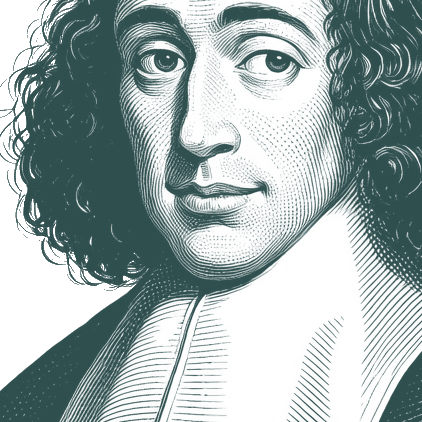
Benedictus de Spinoza (24 November 1632 – 21 February 1677) was a social and metaphysical philosopher known for the elaborate development of his monist philosophy, which has become known as Spinozism. Controversy regarding his ideas led to his excommunication from the Jewish community of his native Amsterdam. He was named Baruch ("blessed" in Hebrew) Spinoza by his synagogue elders and known as Bento de Spinoza or Bento d'Espiñoza, but afterwards used the name Benedictus ("blessed" in Latin) de Spinoza.
Native Name:
בָּרוּךְ שְׂפִּינוֹזָה
•
Benedito de Espinosa
Alternative Names:
Benedict de Spinoza
•
Baruch de Espinosa
•
Barukh Shpinozah
•
Benoît de Spinoza
•
Sbīnūzā
•
Ispīnūzā
•
Barukh Spinoza
•
Bento de Espinosa
•
Baruch d' Espinoza
•
Shpinozah
•
Baruch de Spinoza
•
Spinoza
•
Benoit de Spinoza
•
Benedictus De Spinoza
•
Benedictus Spinoza
•
Baruch Spinoza
•
Baruch Benedictus de Spinoza
Spinoza remained throughout his life, and well into the eighteenth century, a thinker whom one could admire only in secret, hiding one's sympathy just as his Marrano antecedents had concealed their wayward Jewishness. Open admiration could destroy even the most established of reputations, well into the eighteenth century's so-called Age of Reason. In the 1780s, for example, Friedrich Heinrich Jacobi launched a generalized attack on Enlightenment thought by claiming that the late poet Lessing had been a closet Spinozist, a charge sufficient to compromise the entire movement for which Lessing had been a leading spokesman. Jacobi even went after Immanuel Kant and his successors, arguing that "consistent philosophy is Spinozist, hence pantheist, fatalist, and atheist."
You know that I do not share your opinion in this matter. That Spinozism and Atheism are to me two different things. That when I read Spinoza I can only explain him by reference to himself and that if it came to naming a book which, of all that I know, most agrees with my way of seeing things, then I would have to name the Ethics—even though by nature I do not share his way of seeing things. [Original in German: Du weißt daß ich über die Sache selbst nicht deiner Meinung bin. Daß mir Spinozismus und Atheismus zweyerlei ist. Daß ich den Spinoza wenn ich ihn lese mir nur aus sich selbst erklären kann, und daß ich, ohne seine Vorstellungsart von Natur selbst zu haben, doch wenn die Rede wäre ein Buch anzugeben, das unter allen die ich kenne, am meisten mit der meinigen übereinkommt, die Ethik nennen müsste.]
Enhance Your Quote Experience
Enjoy ad-free browsing, unlimited collections, and advanced search features with Premium.