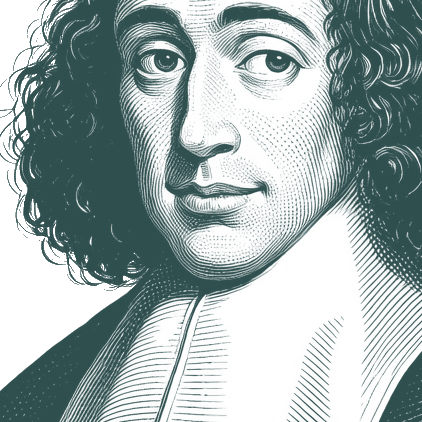
It is unquestionably the peacefulness and calm of the Spinozist system which particularly produces the idea of its depth, and which, with hidden but … - Benedictus de Spinoza
""
It is unquestionably the peacefulness and calm of the Spinozist system which particularly produces the idea of its depth, and which, with hidden but irresistible charm, has attracted so many minds. The Spinozist system will also always remain in a certain sense a model. A system of freedom — but with just as great contours, with the same simplicity, as a perfect counter-image (Gegenbild) of the Spinozist system — this would really be the highest system. This is why Spinozism, despite the many attacks on it, and the many supposed refutations, has never really become something truly past, never been really overcome up to now, and no one can hope to progress to the true and the complete in philosophy who has not at least once in his life lost himself in the abyss of Spinozism. Nobody who wishes to arrive at his own firm conviction should leave unread the main work of Spinoza, his Ethics (for he presented his system under this title), and I should like to urge everyone who is seriously concerned with his education not only to study assiduously on his own, which no teacher can replace, but to be most conscientious and careful in the choice of what he reads.
Benedictus de Spinoza (24 November 1632 – 21 February 1677) was a social and metaphysical philosopher known for the elaborate development of his monist philosophy, which has become known as Spinozism. Controversy regarding his ideas led to his excommunication from the Jewish community of his native Amsterdam. He was named Baruch ("blessed" in Hebrew) Spinoza by his synagogue elders and known as Bento de Spinoza or Bento d'Espiñoza, but afterwards used the name Benedictus ("blessed" in Latin) de Spinoza.
Native Name:
בָּרוּךְ שְׂפִּינוֹזָה
•
Benedito de Espinosa
Alternative Names:
Benedict de Spinoza
•
Baruch de Espinosa
•
Barukh Shpinozah
•
Benoît de Spinoza
•
Sbīnūzā
•
Ispīnūzā
•
Barukh Spinoza
•
Bento de Espinosa
•
Baruch d' Espinoza
•
Shpinozah
•
Baruch de Spinoza
•
Spinoza
•
Benoit de Spinoza
•
Benedictus De Spinoza
•
Benedictus Spinoza
•
Baruch Spinoza
•
Baruch Benedictus de Spinoza
The various critics who have assumed that Spinoza held a paramount position in Goethe's world view have much direct evidence from Goethe's own pen. In one of the Zahme Xenien Goethe calls Spinoza "the philosopher whom I trust most." From the 1780's onward numerous references to Spinoza appear in Goethe's work. How well Goethe knew Spinoza's philosophy before his arrival at Weimar is a matter of some uncertainty, but already in 1773 a book of Spinoza's, probably the Ethics, is mentioned as an object of his study. The letters of 1784-86 indicate that Goethe read and discussed the Ethics with Charlotte von Stein and that he disputed with Friedrich Heinrich Jacobi about Spinoza's concept of God/Nature. During that same period Goethe had written that although he did not himself share Spinoza's way of representing nature (seine Vorstellungsart von Natur), if he were to name one book that agreed the most completely with his own conception of nature, it would have to be the Ethics: doch wenn die Rede wäre ein Buch anzugeben, das unter allen die ich kenne, am meisten mit der meinigen übereinkommt, die Ethik nennen müsste. In a conversation with Boisserée of August 3, 1815, Goethe said: "I always carry the Ethics of Spinoza with me." The most extended references to Spinoza are to found in Goethe's autobiography Poetry and Truth.
If you find the light of Scripture clearer than the light of reason (which also is given us by divine wisdom), you are doubtless right in your own conscience in making your reason yield. For my part, since I plainly confess that I do not understand the Scriptures, though I have spent many years upon them, and since I know that when once I have a firm proof I cannot by any course of thought come to doubt of it, I rest wholly upon that which my understanding commends to me, without any suspicion that I am deceived therein, or that the Scriptures, even though I do not search them, can speak against it. For one truth cannot conflict with another, as I have already clearly shown in my Appendix to the "Principles of Descartes"...But if in any case I did find error in that which I have collected from my natural understanding, I should count it good fortune, since I enjoy life, and endeavour to pass it not in weeping and sighing, but in peace, joy, and cheerfulness, and from time to time climb thereby a step higher. I know, meanwhile (which is the highest pleasure of all), that all things happen by the power and unchangeable decree of the most perfect Being.
Go Premium
Support Quotewise while enjoying an ad-free experience and premium features.
En la reminiscencia, en efecto, el alma tiene el pensamiento de esta sensación, pero no en la continuidad de su duración. Así, la idea de la sensación no es la duración misma de la sensación, es decir, ella no es propiamente su memoria. En cuanto a saber si las ideas mismas están sujetas a alguna corrupción, lo veremos en la Filosofía.