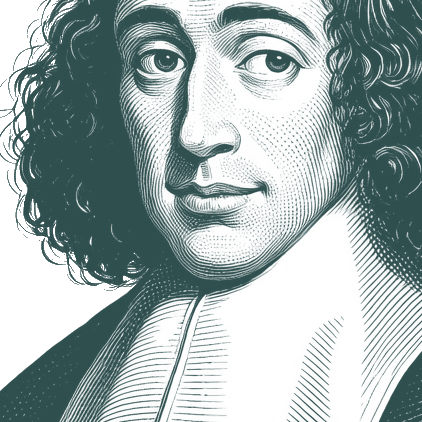
Indeed, just as light makes manifest both itself and darkness, so truth is the standard both of itself and falsity. - Benedictus de Spinoza
""
Indeed, just as light makes manifest both itself and darkness, so truth is the standard both of itself and falsity.
English
Collect this quote
About
Benedictus de Spinoza
Benedictus de Spinoza (24 November 1632 – 21 February 1677) was a social and metaphysical philosopher known for the elaborate development of his monist philosophy, which has become known as Spinozism. Controversy regarding his ideas led to his excommunication from the Jewish community of his native Amsterdam. He was named Baruch ("blessed" in Hebrew) Spinoza by his synagogue elders and known as Bento de Spinoza or Bento d'Espiñoza, but afterwards used the name Benedictus ("blessed" in Latin) de Spinoza.
Native Name:
בָּרוּךְ שְׂפִּינוֹזָה
•
Benedito de Espinosa
Alternative Names:
Benedict de Spinoza
•
Baruch de Espinosa
•
Barukh Shpinozah
•
Benoît de Spinoza
•
Sbīnūzā
•
Ispīnūzā
•
Barukh Spinoza
•
Bento de Espinosa
•
Baruch d' Espinoza
•
Shpinozah
•
Baruch de Spinoza
•
Spinoza
•
Benoit de Spinoza
•
Benedictus De Spinoza
•
Benedictus Spinoza
•
Baruch Spinoza
•
Baruch Benedictus de Spinoza
The oldest recorded form of the rule, and that which has the most positive character, is contained in the command of the Jewish law, "Thou shalt love thy neighbour as thyself," (Leviticus xix. 18), (neighbour including "stranger that dwelleth with you," v. 34), which stands in the same relation to the individualistic maxim as Fraternity to Equity. The strength of Judaism as a social organisation has resided in its unflinching advocacy of freedom, within the law; equality, before the law; and fraternity, outside the law. I am not sure that, from the purely philosophical point of view, the form in which that great Jew, Spinoza, has stated the rule is not the best: "Desire nothing for yourself which you do not desire for others," (nihi sibi appetere quod reliquis hominibus non cupiant). (Ethics, iv. xviii.)
Homo liber de nulla re minus, quam de morte cogitat, et ejus sapientia non mortis, sed vitae meditatio est.
Works in ChatGPT, Claude, or Any AI
Add semantic quote search to your AI assistant via MCP. One command setup.
That our modern natural sciences have become so thoroughly entangled in this Spinozistic dogma (most recently and worst of all, Darwinism with its incomprehensibly onesided doctrine of the “struggle for existence”) is probably due to the origins of most natural scientists: In this respect they belong to the “common people”; their ancestors were poor and undistinguished people who knew the difficulties of survival only too well at firsthand.