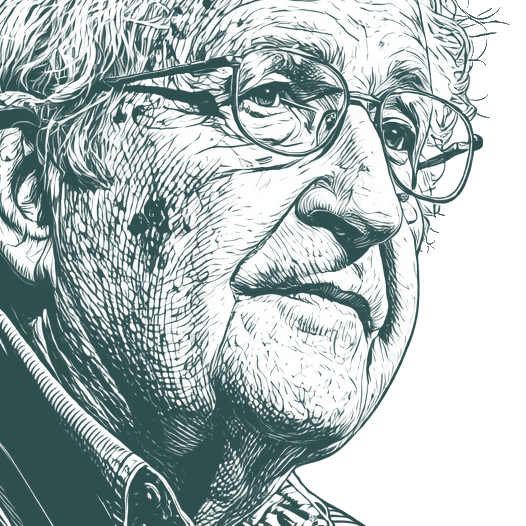
The "corporatization of America" during the past century has been an attack on democracy—and on markets, part of the shift from something resembling … - Noam Chomsky
""
The "corporatization of America" during the past century has been an attack on democracy—and on markets, part of the shift from something resembling "capitalism" to the highly administered markets of the modern state/corporate era. A current variant is called "minimizing the state," that is, transferring decision-making power from the public arena to somewhere else: "to the people" in the rhetoric of power; to private tyrannies, in the real world.
Avram Noam Chomsky (born 7 December 1928) is an American linguist, analytical philosopher, cognitive scientist, political analyst, human rights activist and anarcho-socialist.
Biography information from
Wikiquote·
Portrait adapted from
Wikimedia Commons, Augusto Starita / Ministerio de Cultura de la Nación (CC BY-SA)
The war was a “tragic error,” but not “fundamentally wrong or immoral” (as the overwhelming majority of the American people continue to believe), and surely not criminal aggression - the judgment that would be reached at once on similar evidence if the responsible agent were not the USA, or an ally or client. Our point is not that the retrospectives fail to draw what seem to us, as to much of the population, the obvious conclusions; the more significant and instructive point is that principled objection to the war as “fundamentally wrong and immoral,” or as an outright criminal aggression - a war crime - is inexpressible. It is not part of the spectrum of discussion. The background for such a principled critique cannot be developed in the media, and the conclusions cannot be drawn. It is not present even to be refuted. Rather, the idea is unthinkable. All of this reveals with great clarity how foreign to the mobilized media is a conception of the media as a free system of information and discussion, independent of state authority and elite interests.
There is a noticeable general difference between the sciences and mathematics on the one hand, and the humanities and social sciences on the other. It's a first approximation, but one that is real. In the former, the factors of integrity tend to dominate more over the factors of ideology. It's not that scientists are more honest people. It's just that nature is a harsh taskmaster. You can lie or distort the story of the French Revolution as long as you like, and nothing will happen. Propose a false theory in chemistry, and it'll be refuted tomorrow.
The phonological component of a grammar determines the phonetic form of a sentence generated by the syntactic rules. That is, it relates a structure generated by the syntactic component to a phonetically represented signal. The semantic component determines the semantic interpretation of a sentence. That is, it relates a structure generated by the syntactic component to a certain semantic representation.