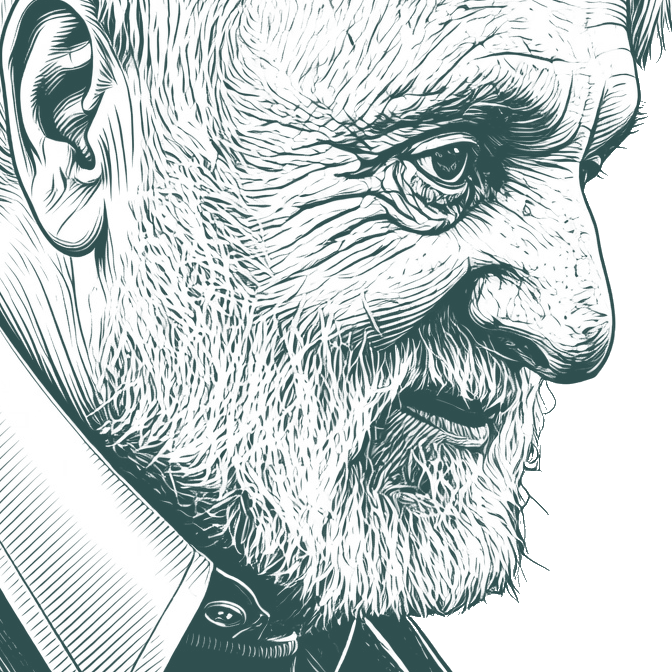
I know what it is! We’ve arrived at the West Coast! We’re all strangers again! Folks, I just forgot the biggest gumption trap of all. The funeral pro… - Robert M. Pirsig
""
I know what it is! We’ve arrived at the West Coast! We’re all strangers again! Folks, I just forgot the biggest gumption trap of all. The funeral procession! The one everybody’s in, this hyped-up, fuck-you, supermodern, ego style of life that thinks it owns this country.
English
Collect this quote
About
Robert M. Pirsig
Robert Maynard Pirsig (6 September 1928 – 24 April 2017) was an American philosopher and novelist, most famous for his novel Zen and the Art of Motorcycle Maintenance in which he proposed what has become known as his Metaphysics of Quality (MoQ).
Biography information from
Wikiquote·
Portrait adapted from
Wikimedia Commons, Ian Glendinning, en:User:IanGlendinning (CC BY)
Also Known As
Alternative Names:
Robert Maynard Pirsig
•
Robert Pirsig
Dialectic generally means "of the nature of the dialogue," which is a conversation between two persons. Nowadays it means logical argumentation. It involves a technique of cross-examination, by which truth is arrived at.
I want to talk about another kind of high country now in the world of thought, which in some ways, for me at least, seems to parallel or produce feelings similar to this, and call it the high country of the mind.
If all of human knowledge, everything that’s known, is believed to be an enormous hierarchic structure, then the high country of the mind is found at the uppermost reaches of this structure in the most general, the most abstract considerations of all.
Few people travel here. There’s no real profit to be made from wandering through it, yet like this high country of the material world all around us, it has its own austere beauty that to some people makes the hardships of traveling through it seem worthwhile.
In the high country of the mind one has to become adjusted to the thinner air of uncertainty, and to the enormous magnitude of questions asked, and to the answers proposed to these questions. The sweep goes on and on and on so obviously much further than the mind can grasp one hesitates even to go near for fear of getting lost in them and never finding one’s way out.
Go Premium
Support Quotewise while enjoying an ad-free experience and premium features.
After a while he says, “Do you believe in ghosts?” “No,” I say. “Why not?” “Because they are un-sci-en-ti-fic.” The way I say this makes John smile. “They contain no matter,” I continue, “and have no energy and therefore, according to the laws of science, do not exist except in people’s minds.” The whiskey, the fatigue and the wind in the trees start mixing in my mind. “Of course,” I add, “the laws of science contain no matter and have no energy either and therefore do not exist except in people’s minds. It’s best to be completely scientific about the whole thing and refuse to believe in either ghosts or the laws of science. That way you’re safe. That doesn’t leave you very much to believe in, but that’s scientific too.