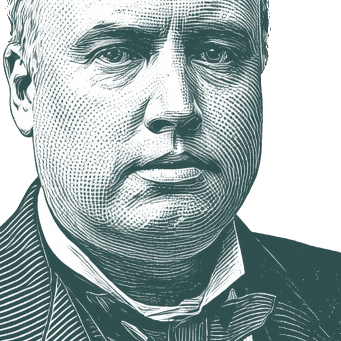
Robert Green Ingersoll (August 11, 1833 – July 21, 1899) was a lawyer, a Civil War veteran, political leader, and orator of the United States during the Golden Age of Freethought, noted for his broad range of culture and his defense of agnosticism. He was nicknamed "The Great Agnostic".
Biography information from
Wikiquote·
Portrait adapted from
Wikimedia Commons, Mathew Benjamin Brady / Levin Corbin Handy (Public domain / CC0)
Also Known As
Alternative Names:
Robert Ingersoll
•
The Great Agnostic
•
Robert G. Ingersoll
Portrait from Wikimedia Commons. Credit: Mathew Benjamin Brady / Levin Corbin Handy. Used under Public domain / CC0. Processed and styled by Quotewise.
Go Premium
Support Quotewise while enjoying an ad-free experience and premium features.
The Good Samaritan was not a Hebrew. He was not one of “the chosen people.” He was a poor, “miserable heathen,” who knew nothing about the Jehovah of the Old Testament, and who had never heard of the “scheme of salvation.” And yet, according to Christ, he was far more charitable than the Levites—the priests of Jehovah, the highest of “the chosen people.” Is it not perfectly plain from this story that charity was in the world before Christianity was established?
Among the “some two hundred and fifty-eight” Vicars of Christ there were probably some good men. This would have happened even if the intention had been to get all bad men, for the reason that man reaches perfection neither in good nor in evil; but if they were selected by Christ himself, if they were selected by a church with a divine origin and under divine guidance, then there is no way to account for the selection of a bad one. If one hypocrite was duly elected pope—one murderer, one strangler, one starver—this demonstrates that all the popes were selected by men, and by men only, and that the claim of divine guidance is born of zeal and uttered without knowledge.
Try QuoteGPT
Chat naturally about what you need. Each answer links back to real quotes with citations.
Is it necessary that Heaven should borrow its light from the glare of Hell?
Infinite punishment is infinite cruelty, endless injustice, immortal meanness. To worship an eternal gaoler hardens, debases, and pollutes even the vilest soul. While there is one sad and breaking heart in the universe, no good being can be perfectly happy.
Against the heartlessness of the Christian religion every grand and tender soul should enter solemn protest. The God of Hell should be held in loathing, contempt and scorn. A God who threatens eternal pain should be hated, not loved – cursed, not worshiped. A heaven presided over by such a God must be below the lowest hell. I want no part in any heaven in which the saved, the ransomed and redeemed will drown with shouts of joy the cries and sobs of hell – in which happiness will forget misery, where the tears of the lost only increase laughter and double bliss.
The idea of hell was born of ignorance, brutality, fear cowardice, and revenge. This idea testifies that our remote ancestors were the lowest beasts. Only from dens, lairs, and caves, only from mouths filled with cruel fangs, only from hearts of fear and hatred, only from the conscience of hunger and lust, only from the lowest and most debased could come this cruel, heartless and bestial of all dogmas.