After Plotinus, says Schassler, fifteen centuries passed without the slightest scientific interest for the world of beauty and art. ...In reality, no… - Leo Tolstoy
""
After Plotinus, says Schassler, fifteen centuries passed without the slightest scientific interest for the world of beauty and art. ...In reality, nothing of the kind happened. The science of aesthetics ... neither did nor could vanish, because it never existed. ... the Greeks were so little developed that goodness and beauty seemed to coincide. On that obsolete Greek view of life the science of aesthetics was invented by men of the eighteenth century, and especially shaped and mounted in Baumgarten's theory. The Greeks (as anyone may read in Bénard's book on Aristotle and Walter's work on Plato) never had a science of aesthetics.
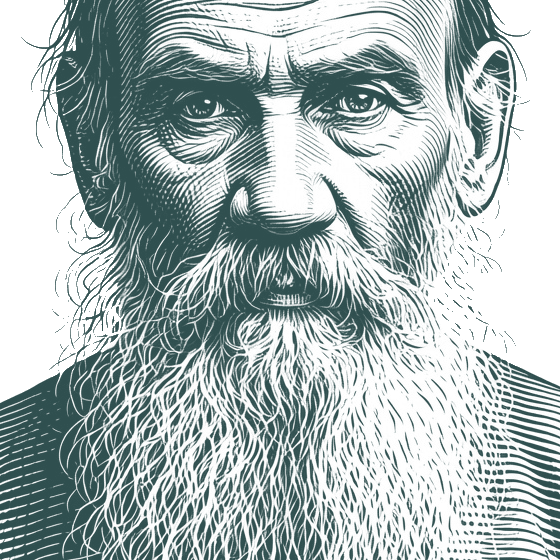
Lev Nikolayevitch Tolstoy [Ле́в Никола́евич Толсто́й, usually rendered Leo Tolstoy, or sometimes Tolstoi] (9 September 1828 – 20 November 1910) was a Russian writer, philosopher and social activist (social critic), whose novels War and Peace and Anna Karenina are internationally praised classics of world literature. He was a major influence on the development of Christian anarchism and pacifism, contributing to such nonviolent resistance movements as those of Mahatma Gandhi, Martin Luther King, Jr., and James Bevel.
Biography information from
Wikiquote·
Portrait adapted from
Wikimedia Commons, Sergei Prokudin-Gorskii (Public domain / CC0)
Also Known As
Pen Names:
Л. Н. Т.
•
Л. Н.
Birth Name:
Lev Nikolayevich Tolstoy
Native Name:
Лев Никола́евич Толсто́й
Alternative Names:
Count Lev Nikolayevich Tolstoy
•
Tolstoy, Leo, graf, 1828-1910
•
Tolstoĭ, Lev Nikolaevich, graf, 1828-1910
•
Lev Nikolayevich Tolstoĭ
•
Leo Tolstoi
•
Tolstoĭ, Lev Nikolaevich, graf
•
Tolstoy, Leo, graf
The universal hypocrisy has so entered into the flesh and blood of all classes of our modern society, it has reached such a pitch that nothing in that way can rouse indignation. Hypocrisy in the Greek means "acting," and acting—playing a part—is always possible.
إني أعتبر التغلغل إلى اعماق مشاعرك وأحاسيسك تطفلاً لايحق لأحد أن يجنح إليه ، حتى ولو كان زوجك .. بل إني على يقين من أن لمثل هذه الخطوة عواقب وخيمة ، لأن المرء إذا حاول استكشاف الروح رأي في الغالب مايبطنه ويخيب أمله .. فشعورك ملك لك ، شعورك موكول إلى ضميرك ، ’’ /
"Thoughts that have important consequences are always simple. All my thinking could be summed up with these words: "Since corrupt people unite amongst themselves to constitute a force, then honest people must do the same." It's as simple as that."