For the nature of duration is such that a greater or lesser than a given duration can always be conceived, as is the case with number. You will perha… - Benedictus de Spinoza
""
For the nature of duration is such that a greater or lesser than a given duration can always be conceived, as is the case with number. You will perhaps insist that God has been from eternity and so has endured until the present, and thus there is a duration other than which a greater cannot be conceived. But in this way there is attributed to God a duration consisting of parts, which we have abundantly refuted when we demonstrated that there pertains to God not duration, but eternity. Would that men had thoroughly considered this truth, for then they might very easily have extricated themselves from many arguments and absurdities, and have given themselves up with the greatest delight to the blessed contemplation of this being.
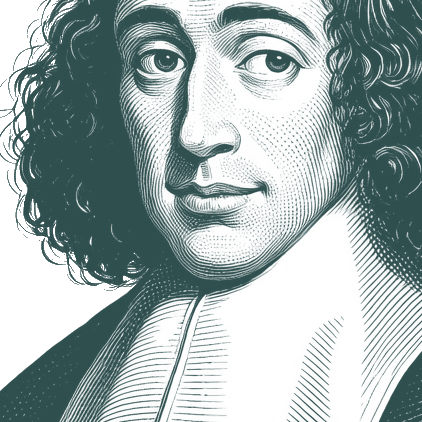
Benedictus de Spinoza (24 November 1632 – 21 February 1677) was a social and metaphysical philosopher known for the elaborate development of his monist philosophy, which has become known as Spinozism. Controversy regarding his ideas led to his excommunication from the Jewish community of his native Amsterdam. He was named Baruch ("blessed" in Hebrew) Spinoza by his synagogue elders and known as Bento de Spinoza or Bento d'Espiñoza, but afterwards used the name Benedictus ("blessed" in Latin) de Spinoza.
Native Name:
בָּרוּךְ שְׂפִּינוֹזָה
•
Benedito de Espinosa
Alternative Names:
Benedict de Spinoza
•
Baruch de Espinosa
•
Barukh Shpinozah
•
Benoît de Spinoza
•
Sbīnūzā
•
Ispīnūzā
•
Barukh Spinoza
•
Bento de Espinosa
•
Baruch d' Espinoza
•
Shpinozah
•
Baruch de Spinoza
•
Spinoza
•
Benoit de Spinoza
•
Benedictus De Spinoza
•
Benedictus Spinoza
•
Baruch Spinoza
•
Baruch Benedictus de Spinoza
After 1785 public opinion of Spinoza changed from almost universal contempt to almost universal admiration, largely as a result of the publication of Jacobi's Briefe, in which he revealed Lessing's Spinozism. Lessing was the most admired figure of the Aufklarung, and his credo automatically gave a stamp of legitimacy to every secret Spinozist. One after another the Spinozists could now come out of their closets and form a file behind Lessing. If Lessing was an honorable man and a Spinozist, then they could be too. Ironically, Jacobi's Briefe did not destroy Lessing's reputation, as Mendelssohn feared. It did the very opposite, making him a hero in the eyes of the nonconformists. Lessing made it a fashion to be unorthodox; and to be fashionably unorthodox was to be a Spinozist. Of course, Lessing's credo explains only how Spinozism became respectable. It accounts for why a Spinozist might go public, but not for why he became a Spinozist in the first place. To understand why Spinozism became the credo of so many other thinkers, we have to consider the new situation of the sciences at the close of the eighteenth century. The rise in the fortunes of Spinozism resulted in part from the consequence of the decline of theism and deism.
Philopon: The misfortune of this man has always touched me in an extraordinary way. He lived in moderation, alone and irreproachable; he renounced all human idols and devoted his entire life to reflection, and look what happened! In the labyrinth of his meditations, he goes astray and, out of error, maintains much that agrees very little with his innocent way of life and that the most depraved scoundrel might wish for in order to be able to indulge his evil desires with impunity. How unjust is the irreconcilable hatred of scholars towards someone so unfortunate!
Works in ChatGPT, Claude, or Any AI
Add semantic quote search to your AI assistant via MCP. One command setup.
While Schelling was wrestling with Plato, Spinoza, and Kant, his contemporary Hegel was struggling with Spinoza exclusively. In Hegel, Spinoza reached the height of his influence upon the German mind. Hegel was the most influential, although not the most original, German philosopher since the days of Kant. His system was more an absorption of other systems than an original creation. Therein lies the secret of his influence. He brought all the philosophical tendencies and moods of his time to a conclusion. With him the pantheism of his period attained its highest development and became the conscious and necessary connection of the mind and the world. During his entire philosophical career, Hegel constantly wrestled with Spinoza and for a time was entirely in his clutches. It was while under this influence that Hegel said that in order to refute Spinoza one must first accept him. In his lectures on the history of philosophy he says, "That Spinoza is the main point in modern philosophy, it is either Spinozism or no philosophy at all." He defended Spinoza against the reproach that his philosophy was atheistic and destructive of morality. In his later years, however, when he became more conservative, he changed his attitude toward Spinoza. He said, "that the philosophy of the "Amsterdam hermit" was an antiquated point of view, that his method was 'wooden,' that his proofs were formal tortures, that the attributes did not emanate from the substance and that the modi did not emanate from the attributes." But it was reserved for his old age to discover that Spinozism was philosophically objectionable because it did not tally with Christianity.