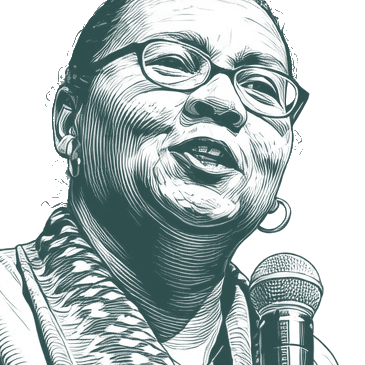
bell hooks (born Gloria Jean Watkins; September 25, 1952 – December 15, 2021), was an American university professor specializing in social criticism focused on groups distinguished by established differences in social power.
Biography information from
Wikiquote·
Portrait adapted from
Wikimedia Commons, Cmongirl (Public domain / CC0)
It is obvious that many women have appropriated feminism to serve their own ends, especially those white women who have been at the forefront of the movement; but rather than resigning myself to this appropriation I choose to re-appropriate the term “feminism,” to focus on the fact that to be “feminist” in any authentic sense of the term is to want for all people, female and male, liberation from sexist role patterns, domination, and oppression.
Those who choose to walk on love's path are well served if they have a guide. That guide can enable us to overcome fear if we trust that they will not lead us astray or abandon us along the way.
Concurrently, the growing class power and public voice of conservative and liberal well-to-do black folks easily obscures the class cruelty these individuals enact both in the way they talk about underprivileged blacks and the way they represent them. The existence of that class cruelty and its fascist dimensions have been somewhat highlighted by the efforts of privileged-class blacks to censor the voices of black youth, particularly gangsta rappers who are opposing bourgeois class values by extolling the values of street culture and street vernacular. Significantly, the attack on urban underclass black youth culture and its gangster dimensions (glamorization of crime, etc.) is usually presented via a critique of sexism. Since most privileged-class blacks have shown no interest in advancing feminist politics, the only organized effort to end sexism and sexist oppression, this attack on sexism seems merely gratuitous, a smoke screen that deflects away from the fact that what really disturbs bourgeois folks is the support of rebellion, unruly behavior, and disrespect for their class values. In reality, they and their white counterparts fear the power these young folks have to change the minds and life choices of youth from privileged classes. If only underclass black folks were listening to gangsta rap, there would be no public effort to silence and censor this music. The fear is that it will generate class rebellion.