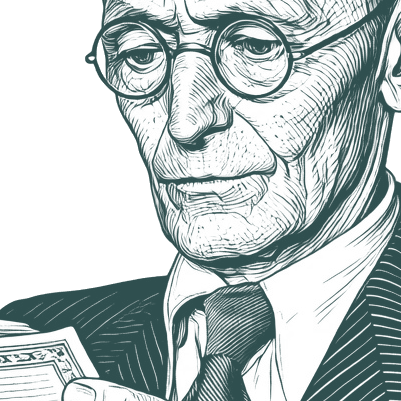
I would traverse not once more, but often the hell of my inner being. One day I would be a better hand at the game. One day I would learn how to laug… - Hermann Hesse
""
I would traverse not once more, but often the hell of my inner being. One day I would be a better hand at the game. One day I would learn how to laugh. Pablo was waiting for me, and Mozart too.
Hermann Karl Hesse (2 July 1877 – 9 August 1962) was a German-Swiss poet, novelist, and painter. In 1946, he received the Nobel Prize in Literature. His most famous works include Steppenwolf, Siddhartha, and The Glass Bead Game (also known as Magister Ludi) all of which explore an individual's search for spirituality.
What you call passion is not a spiritual force, but friction between the soul and the outside world. Where passion dominates, that does not signify the presence of greater desire and ambition, but rather the misdirection of these qualities toward and isolated and false goal, with a consequent tension and sultriness in the atmosphere. Those who direct the maximum force of their desires toward the center, toward true being, toward perfection, seem quieter than the passionate souls because the flame of their fervor cannot always be seen. In argument, for example, they will not shout or wave their arms. But, I assure you, they are nevertheless, burning with subdued fires.
Your faith has found no more air to breathe. And suffocation is a hard death.
Go Premium
Support Quotewise while enjoying an ad-free experience and premium features.
Pious thinkers of earlier times had represented the life of creatures, say, as a mode of motion toward God, and had considered that the variety of the phenomenal world reached perfection and ultimate cognition only in the divine Unity. Similarly, the symbols and formulas of the Glass Bead Game combined structurally, musically, and philosophically within the framework of a universal language, were nourished by all the sciences and arts, and strove in play to achieve perfection, pure being, the fullness of reality.