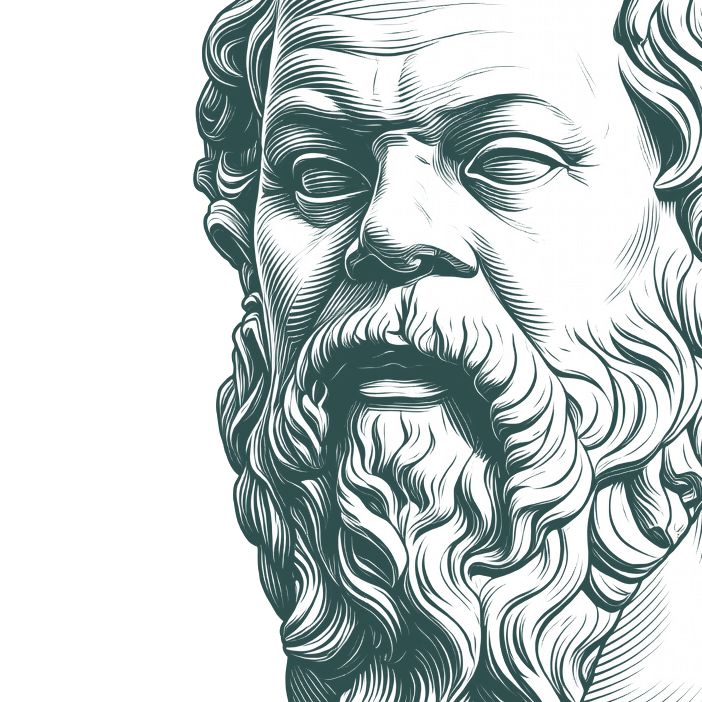
Socrates (Σωκράτης; c. 470 BC – 399 BC) was a classical Greek (Athenian) philosopher credited as one of the founders of Western philosophy. Through his portrayal in Plato's dialogues, Socrates has become renowned for his contribution to the field of ethics, and it is this Platonic Socrates who lends his name to the concepts of Socratic irony and the Socratic method, or elenchus. The latter remains a commonly used tool in a wide range of discussions, and is a type of pedagogy in which a series of questions is asked not only to draw individual answers, but also to encourage fundamental insight into the issue at hand.
Biography information from
Wikiquote·
Portrait adapted from
Wikimedia Commons, Copy of Lysippos (?) (Public domain / CC0)
I am likely to be wiser than he to this small, extent, that I do not think I know what I do not know
To express oneself badly is not only faulty as far as the language goes, but does some harm to the soul.
The soul is in the very likeness of the divine, and immortal, and intelligible, and uniform, and indissoluble, and unchangeable; and the body is in the very likeness of the human, and mortal, and unintelligible, and multiform, and dissoluble, and changeable.