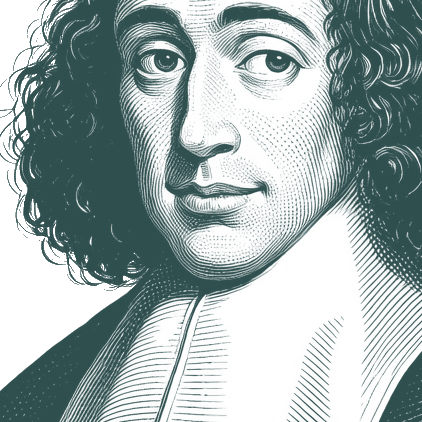
He [Spinoza] believes in authority. And, of course, he believed in freedom of thought and expression, whereas Hobbes does not. There is a book on Spi… - Benedictus de Spinoza
""
He [Spinoza] believes in authority. And, of course, he believed in freedom of thought and expression, whereas Hobbes does not. There is a book on Spinoza written by an American ex-Marxist, called Spinoza and the Rise of Liberalism, on these lines. But Spinoza is not a theorist in whom I am particularly interested, because he is too rationalistic for me. But the Ethics is a wonderful book, and full of deep insights and noble feeling. It is totally unhistorical: the idea of timeless truths about human beings seems suspect to me.
Benedictus de Spinoza (24 November 1632 – 21 February 1677) was a social and metaphysical philosopher known for the elaborate development of his monist philosophy, which has become known as Spinozism. Controversy regarding his ideas led to his excommunication from the Jewish community of his native Amsterdam. He was named Baruch ("blessed" in Hebrew) Spinoza by his synagogue elders and known as Bento de Spinoza or Bento d'Espiñoza, but afterwards used the name Benedictus ("blessed" in Latin) de Spinoza.
Native Name:
בָּרוּךְ שְׂפִּינוֹזָה
•
Benedito de Espinosa
Alternative Names:
Benedict de Spinoza
•
Baruch de Espinosa
•
Barukh Shpinozah
•
Benoît de Spinoza
•
Sbīnūzā
•
Ispīnūzā
•
Barukh Spinoza
•
Bento de Espinosa
•
Baruch d' Espinoza
•
Shpinozah
•
Baruch de Spinoza
•
Spinoza
•
Benoit de Spinoza
•
Benedictus De Spinoza
•
Benedictus Spinoza
•
Baruch Spinoza
•
Baruch Benedictus de Spinoza
Deus est omnium rerum causa immanens, non vero transiens
[...] After a moment he resurfaced, holding two glasses in one hand and a bottle of cheap fruit drink in the other. Energetically, he poured a glass for himself, then he poured one for me and declared: “Drink it!” I drank it all, in a single gulp. Down to the last drop. David Ben-Gurion, meanwhile, took three noisy swallows, like a thirsty peasant, and resumed his lecture on Spinoza. “As a Spinozist I say to you without a shadow of doubt that the whole essence of Spinoza's thought can be summed up as follows. A man should always stay composed! He should never lose his calm! All the rest is hair-splitting and paraphrase. Composure! Calm in any situation! And the rest—frippery!” (Ben-Gurion's peculiar intonation stressed the last syllable of each word with something like a little roar.) By now I could not take the slur on Spinoza's honor any longer. I could not remain silent without betraying my favorite philosopher. So I summoned up all my courage, blinked and by some miracle I dared to open my mouth in the presence of the Lord of All Creation, and even to squeak in a small voice: “It's true that there is calm and composure in Spinoza, but surely it's not right to say that that's the whole essence of Spinoza's thought? Surely there's also...” Then fire and brimstone and streams of molten lava erupted over me from the mouth of the volcano: “I've been a Spinozist all my life! I've been a Spinozist since I was a young man! Composure! Calm! That is the essence of the whole of Spinoza's thought! That's the heart of it! Tranquillity! In good or in evil, in victory or in defeat, a man must never lose his peace of mind! Never!” His two powerful, woodcutter's fists landed furiously on the glass top of the desk, making our two glasses jump and rattle with fear. “A man must never lose his temper!” The worlds were hurled at me like the thunder of judgment day. “Never! And if you can't see that, you don't deserve to be called a Spinozist!” At this he calmed down. He brightened up. He sat down opposite me and spread his arms out wide on his desk as though he was about to clasp everything on it to his breast. A pleasant, heart-melting light radiated from him when he suddenly smiled a simple, happy smile, and it seemed not only as though it was his face and his eyes that smiled but as though his whole fist-like body relaxed and smiled with him, and the whole room smiled too, and even Spinoza himself.
The latter [Descartes] had sharply divided nature into mind and matter, i.e., thinking and extended substance, and had also placed God and the world in complete opposition to each other; Spinoza also, so long as he was a Cartesian, taught all that in his “Cogitatis Metaphysicis,” c. 12, i. I., 1665. Only in his later years did he see the fundamental falseness of that double dualism; and accordingly his own philosophy principally consists of the indirect abolition of these two antitheses. Yet partly to avoid injuring his teacher, partly in order to be less offensive, he gave it a positive appearance by means of a strictly dogmatic form, although its content is chiefly negative. His identification of the world with God has also this negative significance alone. For to call the world God is not to explain it: it remains a riddle under the one name as under the other. But these two negative truths had value for their age, as for every age in which there still are conscious or unconscious Cartesians.