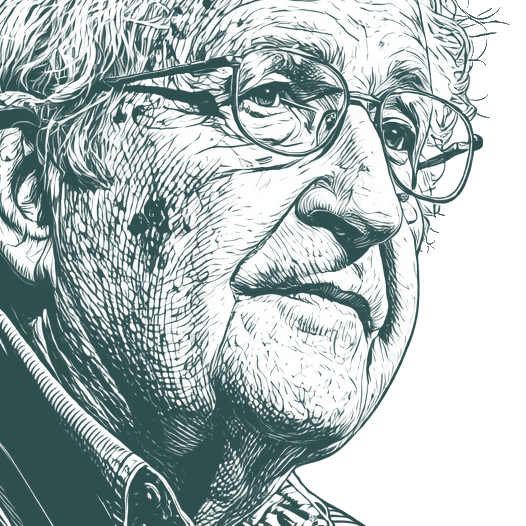
We certainly shouldn't trust to deal with <nowiki>[</nowiki>Saddam Hussein<nowiki>]</nowiki> anyone who supported him through his worst crimes, that'… - Noam Chomsky
""
We certainly shouldn't trust to deal with <nowiki>[</nowiki>Saddam Hussein<nowiki>]</nowiki> anyone who supported him through his worst crimes, that's insane.
English
Collect this quote
About
Noam Chomsky
Avram Noam Chomsky (born 7 December 1928) is an American linguist, analytical philosopher, cognitive scientist, political analyst, human rights activist and anarcho-socialist.
Biography information from
Wikiquote·
Portrait adapted from
Wikimedia Commons, Augusto Starita / Ministerio de Cultura de la Nación (CC BY-SA)
I'm of course opposed to terror, any rational person is, but I think that if we're serious about the question of terror and serious about the question of violence we have to recognize that it is a tactical and hence moral matter. Incidentally, tactical issues are basically moral issues. They have to do with human consequences. And if we're interested in, let's say, diminishing the amount of violence in the world, it's at least arguable and sometimes true that a terroristic act does diminish the amount of violence in the world. Hence a person who is opposed to violence will not be opposed to that terroristic act.
When we talk about [Chinese] economic imperialism, exactly what are we referring to? We’re referring to investment in development programs throughout Eurasia, spanning to Africa, spanning even to Latin America.
Well the idea was, you could get some nice shots of Marine colonels handing out peanut butter sandwiches to starving refugees, and that'd all look great. And so it looked for a couple of weeks, until things started to get unpleasant. As things started to get unpleasant, the United States responded with what's called the Powell Doctrine. The United States has an unusual military doctrine, it's one of the reasons why the U.S. is generally disqualified from peace keeping operations that involve civilians, again, this has to do with sovereignty. U.S. military doctrine is that U.S. soldiers are not permitted to come under any threat. That's not true for other countries. So countries like, say, Canada, the Fiji Islands, Pakistan, Norway, their soldiers are coming under threat all the time. The peace keepers in southern Lebanon for example, are being attacked by Israeli soldiers all the time, and have suffered plenty of casualties, and they don't like it. But U.S. soldiers are not permitted to come under any threat, so when Somali teenagers started shaking fists at them, and more, they came back with massive fire power, and that led to a massacre. According to the U.S., I don't know the actual numbers, but according to U.S. government, about 7 to 10 thousand Somali civilians were killed before this was over. There's a close analysis of all of this by Alex de Waal, who's one of the world's leading specialists on African famine and relief, altogether academic specialist. His estimate is that the number of people saved by the intervention and the number killed by the intervention was approximately in the same ballpark. That's Somalia. That's what's given as a stellar example of the humanitarian intervention.